
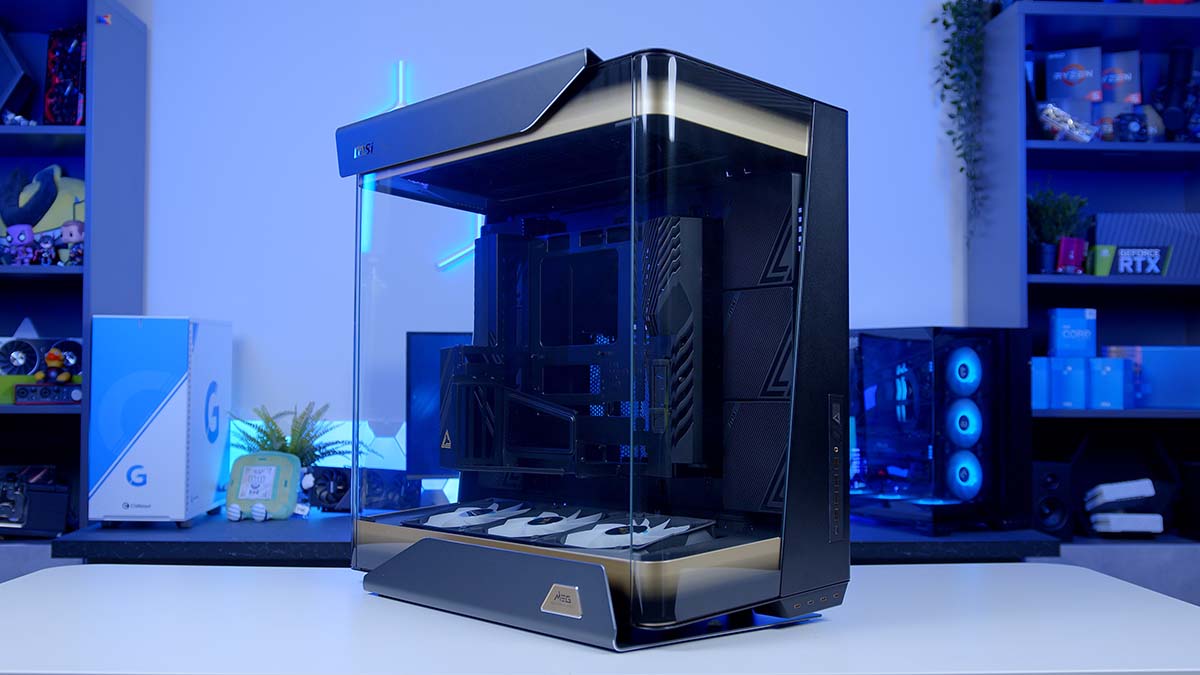
MSI has never done subtle with its MEG range, and the MEG MAESTRO 900R pushes that further than anything the company has put its name to before. This is a full tower designed around presentation rather than raw capacity, with the motherboard, graphics card and cooling hardware all pulled into the middle of the chassis and wrapped in three sides of tempered glass. It’s the sort of case that looks like it was designed for a showroom first and a desk second.
There’s proper engineering underneath the theatre, though. The motherboard tray detaches completely and rotates into four orientations, a Peripheral Component Interconnect Express (PCIe) 5.0 riser cable and vertical graphics card bracket come in the box, and the front input/output (IO) panel carries five USB Type-C ports. Whether all of that justifies a chassis weighing 33kg before a single component goes in is what we’re working through here.
Specifications
Before getting into how the MAESTRO 900R actually builds, it’s worth laying out what MSI has put on the table, because the numbers explain a lot about the decisions made elsewhere. This is a full tower in the most literal sense, measuring 695mm deep, 379mm wide and 671mm tall, and it takes Extended ATX (E-ATX) motherboards alongside the usual ATX, Micro-ATX and Mini-ITX sizes.
Cooling provision is where the sheet gets interesting. Three 160mm addressable RGB (ARGB) reverse blade fans come pre-installed along the bottom, with further mounting across the top, side and bottom of the chassis, and radiator support runs to 420mm along the top and bottom, and 360mm on the side. Storage is unusually generous for a showcase chassis too, with room for up to nine 2.5-inch drives and five 3.5-inch drives, and the eight horizontal plus three vertical expansion slots leave the door open for either a vertically mounted flagship card or a pair of cards sat conventionally.
Case Specifications
- Model MSI MEG MAESTRO 900R
- Form Factor Full Tower
- Motherboard Support E-ATX, ATX, Micro-ATX, Mini-ITX
- Case Dimensions (D x W x H) 695mm x 379mm x 671mm
-
Weight
Net: 33kgGross: 38kg
- Front IO 1 x USB 20Gbps Type-C (60W Power Delivery), 4 x USB 10Gbps Type-C, 4 x USB 5Gbps Type-A, 1 x Audio in/out, 1 x Lighting button, 1 x Power button
- PCI-E Slots 8 x Horizontal 3 x Vertical
- Construction 3mm aluminium panels Triple-sided tempered glass
-
Max Clearance
GPU length: Up to 440mmCPU cooler: Up to 170mmPSU length: Up to 200mm
- Drive Support Up to 9 x 2.5-inch Up to 5 x 3.5-inch
-
Fan Support
Top: 4 x 120mm or 3 x 140mm or 3 x 160mmSide: 6 x 120mmBottom: 4 x 120mm or 3 x 140mm or 3 x 160mm
-
Radiator Support
Top: Up to 420mmSide: Up to 360mmBottom: Up to 420mm
- Power Supply Support ATX
- Pre-Installed Fans Bottom: 3 x 160mm ARGB
The one area that reads as underwhelming is internal clearance. Graphics card support is healthy enough, at up to 440mm, but a maximum processor cooler height of 170mm and a maximum power supply length of 200mm, ATX only, are modest for a chassis of this scale. It’s the clearest sign that the extra volume here has gone on presentation rather than headroom.
What Is Centered Architecture?
Most cases are laid out around structural necessity. The motherboard sits against one wall, the power supply gets tucked into a shroud at the bottom, and the glass panel simply looks in on whatever the frame allows. MSI has gone the other way with the MAESTRO 900R, describing its layout as Centered Architecture, which means the motherboard tray, graphics card and cooling hardware are all positioned in the middle of the chassis rather than at one edge of it.
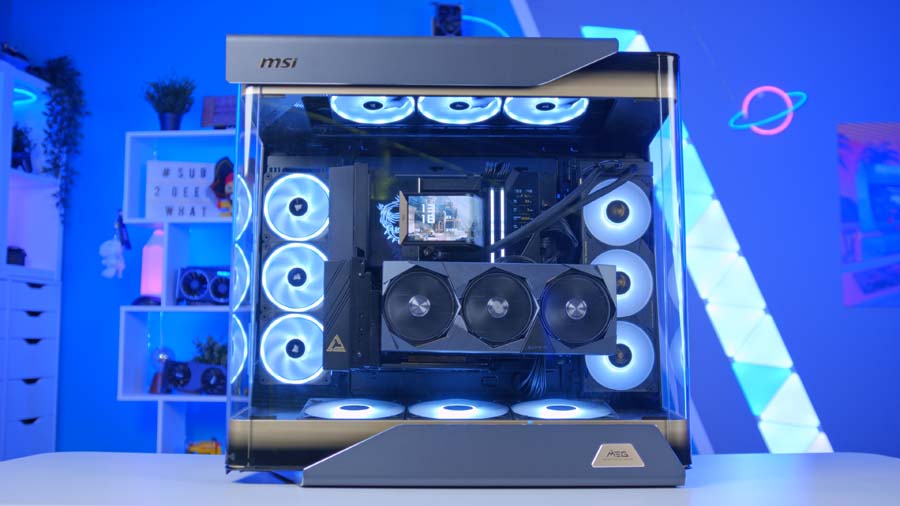
The practical upshot is that your hardware is suspended in open space with glass on three sides, so there’s no dead side and no obvious wrong angle to view the build from. It also frees up the outer edges for cable routing, drive mounting and radiator placement, which is how MSI has managed to fit fan mounts across the top, side and bottom without the layout feeling cramped.
It’s a genuinely different approach rather than a rebadged dual-chamber design, and it explains the footprint. Putting the hardware in the middle means adding depth and width on every side of it, which is why this chassis reads closer to a piece of furniture than a conventional tower.
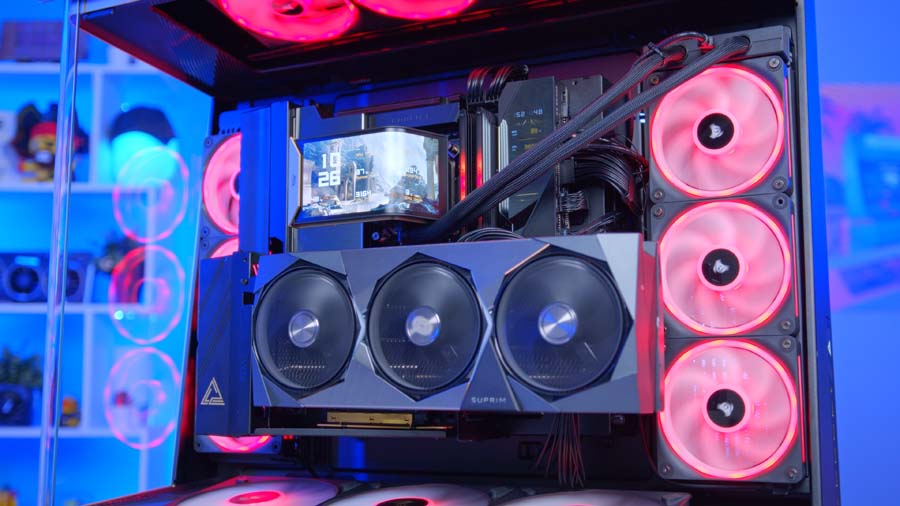
A case built this single-mindedly around presentation invites a build to match it, and the moment you start coordinating panels, lighting and screens to chase the cleanest possible look, naturally, you’ll likely end up shopping largely at MSI. That’s fine for MSI, they want everyone to be shopping their range. But for anyone hoping to fill this case with their favourite hardware pieces from a variety of brands, it’s worth remembering that this chassis has been heavily tailored towards the MSI ecosystem. That pull towards a single, coordinated ecosystem is by design rather than a flaw in the execution but is worth planning ahead for.
Design
The MAESTRO 900R is an intimidating thing to look at, dwarfing a conventional full tower in every direction, and the 33kg empty weight tells you exactly how much aluminium and glass has gone into it. The outer panels are 3mm aluminium finished with diamond-cut chamfers along the edges, and MSI has angled the front and rear profiles at 75 degrees rather than running them dead vertical.
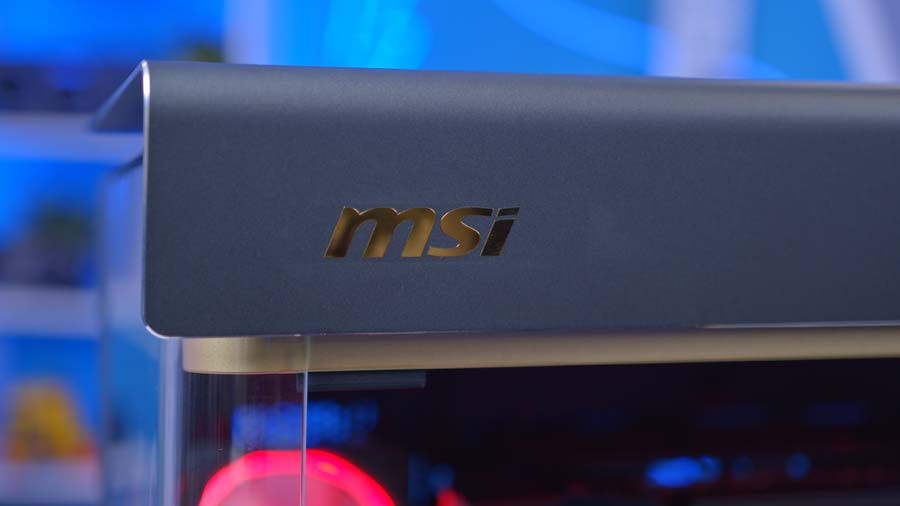
That angle is the detail that gives the silhouette a slight lean and catches light along the chamfered edges, which is the sort of thing that only works when the tolerances are tight enough to keep both lines perfectly parallel. The base is recessed and tapered so the body appears to float above whatever it’s standing on, and the tempered glass wraps across three faces with the joints pulled in tight to keep the view uninterrupted.
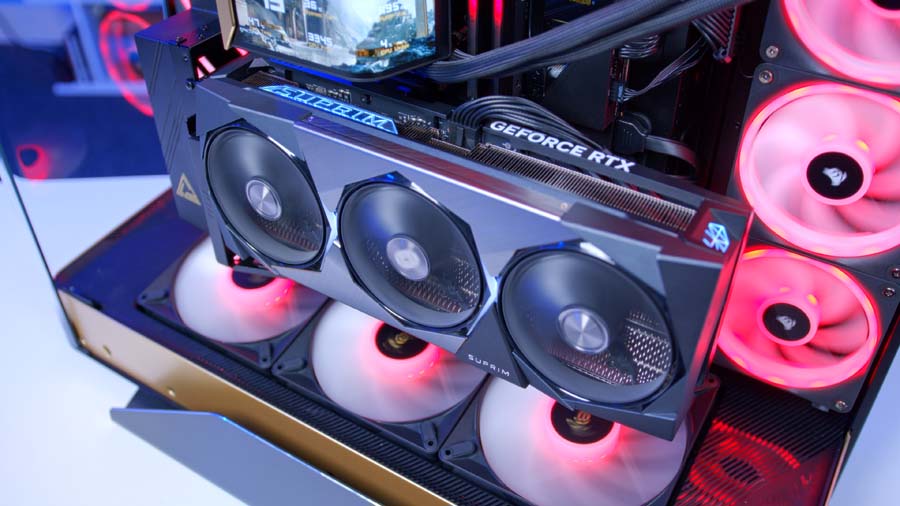
Internally, the layout follows the centred theme all the way through. The pre-installed 160mm fans at the bottom of the chassis feed air upwards through the components, with the top acting as the exhaust. Fan and radiator brackets at the top and bottom can be tilted or rotated up to 90 degrees, so the fans themselves become part of the display rather than something hidden behind a mesh panel.
Features We Like
A Motherboard Tray That Comes Out And Turns Round
The detachable tray is the best idea in the whole chassis. It lifts out completely and works as an open test bench, so the processor, memory, cooler and graphics card can all go on, get cabled and be validated before anything goes near the case itself. Anyone who’s spent an evening reaching over a full tower with a screwdriver held at an awkward angle will understand the appeal immediately.
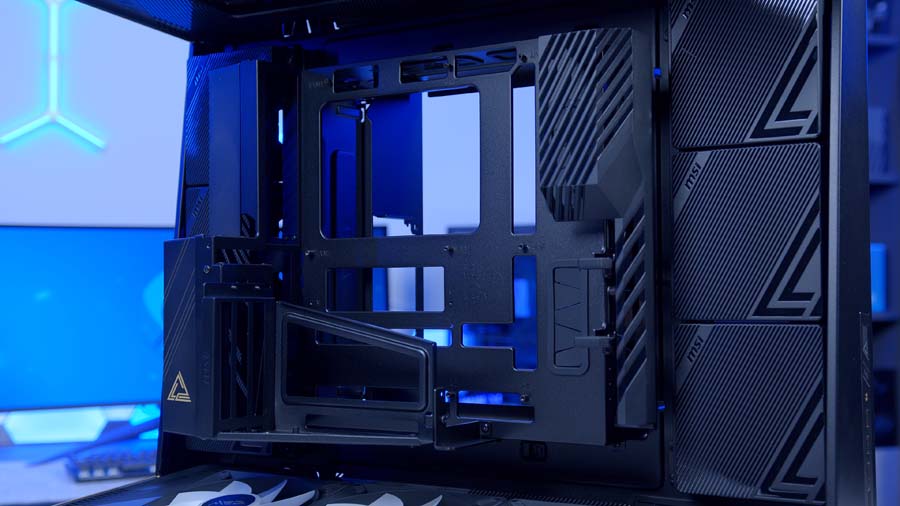
On top of that, the tray drops back in at any of four orientations. That means the same set of components can be arranged to suit airflow, to suit how the case sits relative to the room, or simply to put the graphics card where it looks best. Combined with the front IO module, which can be repositioned to either side depending on which way the case faces, it makes the MAESTRO 900R unusually adaptable for something this rigid-looking.
Front IO Worth Reaching For
Front panel connectivity is usually where premium cases quietly cut corners, offering a single Type-C port and a couple of Type-A alongside the audio jack. MSI has gone considerably further here, fitting five USB Type-C ports in total. Four of those run at 10Gbps, and the fifth is a 20Gbps port with up to 60W of Power Delivery for fast charging, which is enough to keep a laptop or tablet topped up from the front of the case.
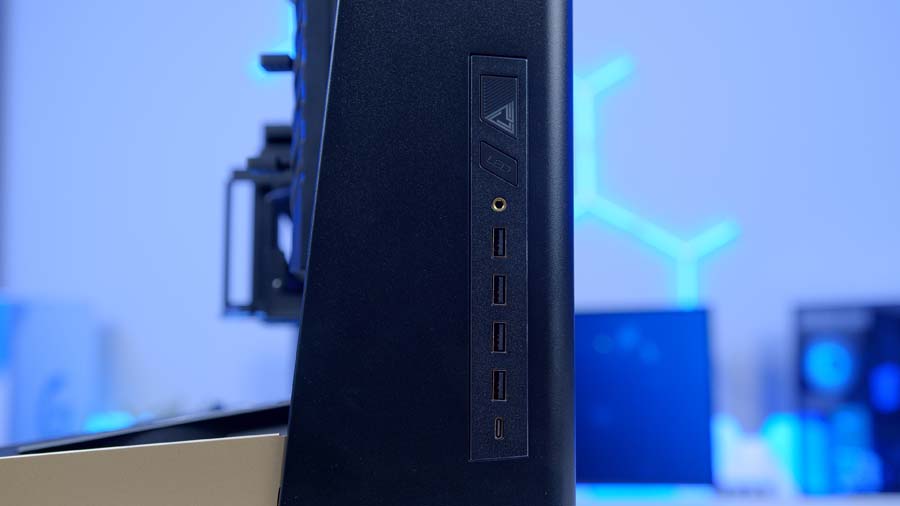
There are four USB 5Gbps Type-A ports as well, plus the combined microphone and audio out jack and a dedicated lighting button. It’s worth flagging that the 60W Power Delivery figure depends on the motherboard supplying it, and MSI lists support as being limited to its own MEG series X870E, X670E, Z890 and Z790 boards. Outside that list you keep the ports, but not the fast charging.
Features We Don’t Like
The Sheer Size And Weight
Thirty-three kilograms empty isn’t a specification, it’s a warning. Add a flagship graphics card, a couple of large radiators, a full complement of fans and a high wattage power supply and you’re realistically looking at something in the region of 45kg to 50kg once the build is finished, which is beyond what a lot of desks are rated to carry.
The footprint is just as demanding. At nearly 700mm deep the MAESTRO 900R needs more clearance than most desks offer, and the whole point of the triple glass and centred layout is that it should be sitting out in the open rather than shoved into a corner. Anyone buying this needs to plan where it goes before they plan what goes in it, and ideally have a second pair of hands available on the day it arrives.
Built For MSI, And Really Only MSI
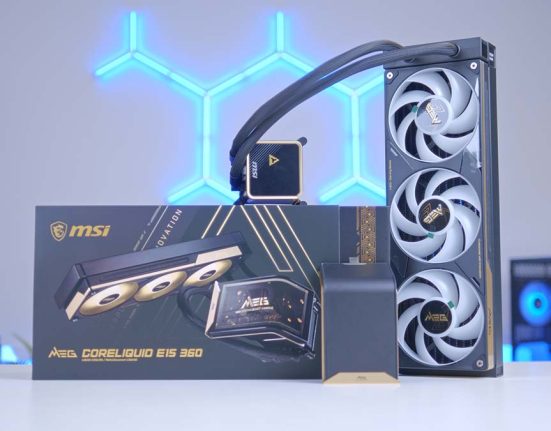
The MAESTRO 900R is so committed to being a showpiece that doing it justice doesn’t merely suggest MSI’s own hardware, it all but demands it. Sit a MEG X870E GODLIKE on the tray, run a MEG CoreLiquid E15 on the cooling and hang a GeForce RTX 5090 SUPRIM up top, and the whole thing locks into one coordinated look, the screens, lighting and finish all speaking the same language. If you can get hold of them, the limited GODLIKE X Edition and RTX 5090 LIGHTNING Z push it further still. Stray outside that short list, though, and the coordination that justifies wrapping three sides in glass quietly comes apart. After spending flagship money on the one component in the build that makes nothing run faster, you don’t end up with your build. You end up with the build that every other owner arrives at from the very same boxes.
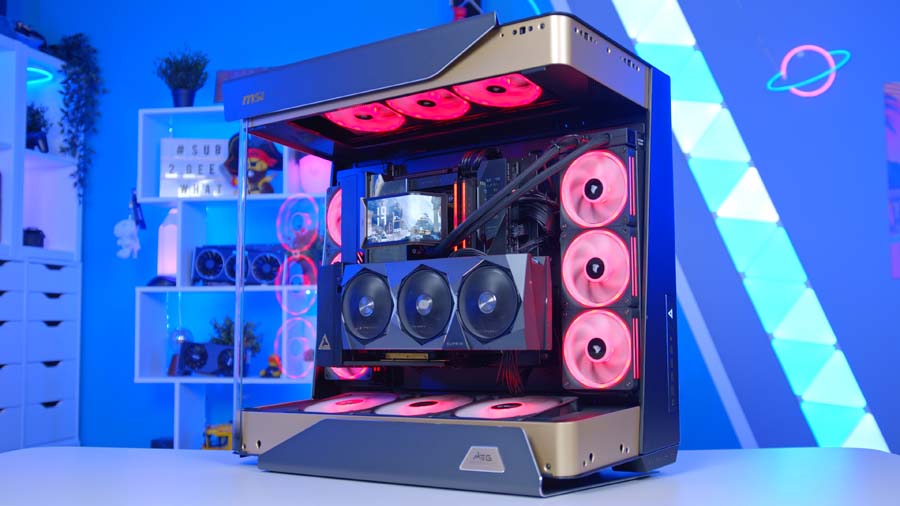
The nudge is in the hardware, not just the styling. That headline 60W of Power Delivery on the front USB Type-C only works with MSI’s own MEG series boards, so even the marquee connectivity quietly rewards staying in the family. Nothing physically stops you fitting whatever you like, and it’ll all bolt in and run. What you trade away is the freedom to make the build feel like yours, and on a case whose whole reason to exist is being looked at, that individuality isn’t a small thing to lose.
Conclusion
Where it shines is presentation. The centred layout suspends your components in open space behind three sides of glass, so there’s no bad angle to view a build from, and the 3mm aluminium panels, diamond-cut chamfers and detachable four-way tray back the spectacle with real engineering. As a thing built to be looked at, few rivals commit to the idea this fully.
Where it struggles is practicality. A 33kg empty weight and a near 700mm depth put it out of reach for most desks, while the cooler-height and power-supply limits are no better than a well-specified mid-tower. For builders with the space and the budget it’s a striking centrepiece, but the audience for it is a narrow one.