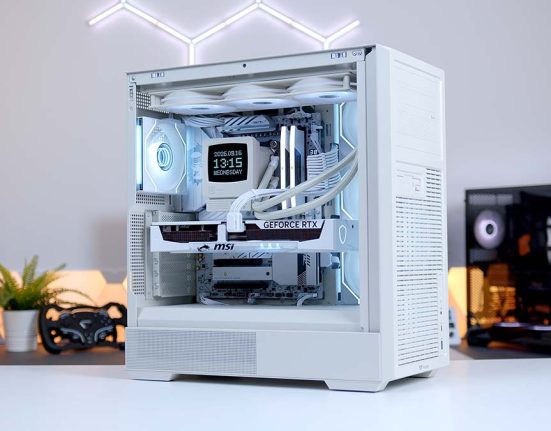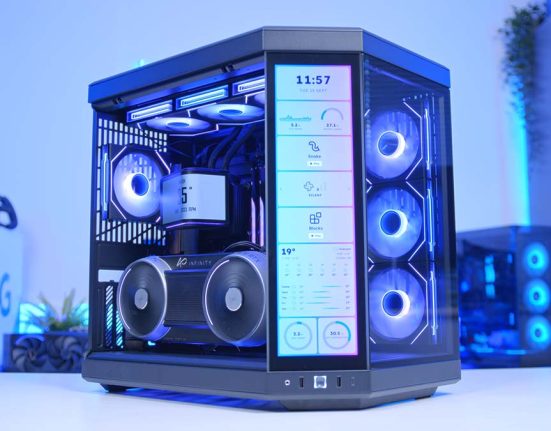

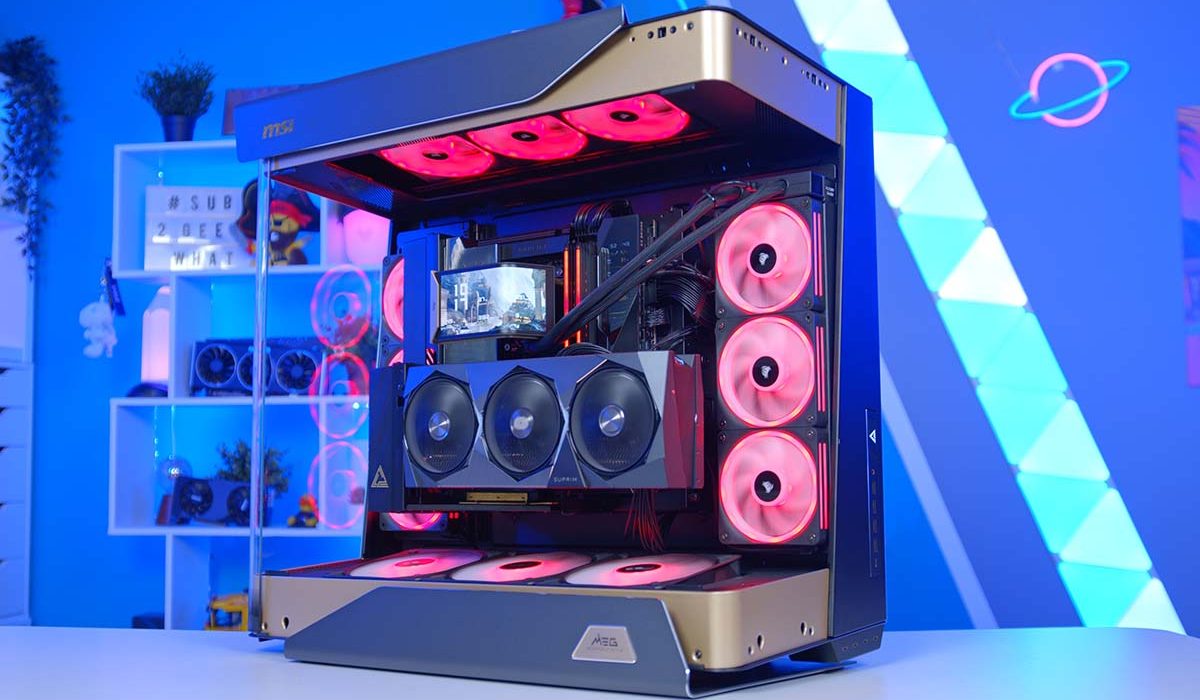
Every so often a parts list turns up where the question isn’t what to compromise on, it’s whether anything got left out. This is one of those. A 9950X3D, an RTX 5090, 8TB of Gen 5 storage, and an MSI chassis so large you’ll want to check what it’s standing on before you build in it.
It’s an all-MSI machine outside the processor, memory and drive, and that’s not an accident. The board, cooler, case and power supply are the top of each MSI range, and they’re designed to talk to each other through one piece of software. Whether that’s worth the outlay is a separate conversation. What it does buy you is a build with no weak link anywhere in it.

AMD Ryzen 9 9950X3D
Skip to SectionSixteen Zen 5 cores with 3D V-Cache on the first CCD. Gaming performance at the top of the chart and enough multi-threaded grunt to render, compile and stream without flinching.
MSI MEG CoreLiquid E15 360
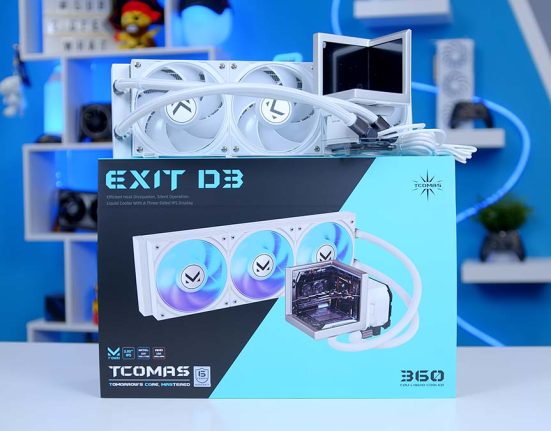
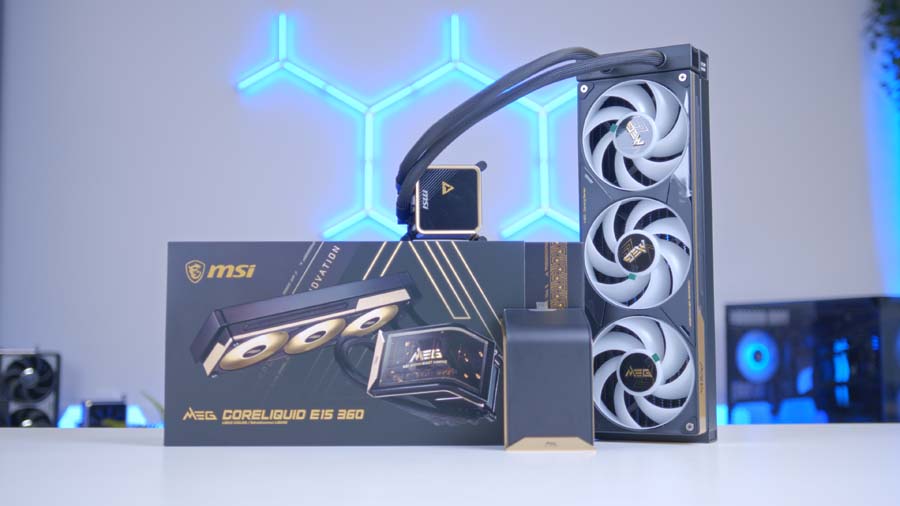
Skip to SectionMSI’s flagship 360mm AIO, topped with a 6.67-inch curved 2K AMOLED panel and a single-frame triple-fan radiator assembly.
MSI MEG X870E GODLIKE X EDITION
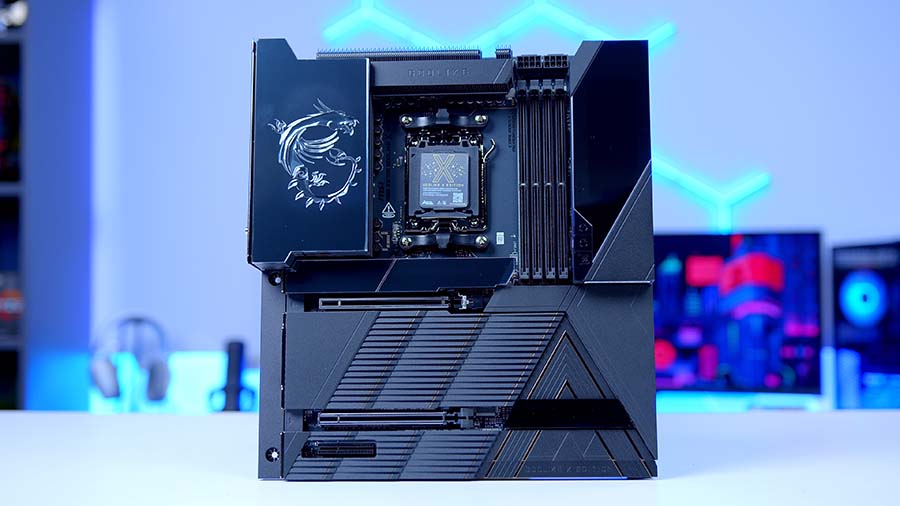
Skip to SectionThe most equipped AM5 board MSI makes, limited to 1,000 numbered units. Seven M.2 slots between board and expansion card, 10G and 5G LAN, and a 24-phase VRM.

Corsair Dominator Titanium Black
Skip to SectionDominator with the Titanium heat spreader and eleven CORSAIR CAPELLIX RGB LEDs per module. Handbuilt, screened dies and a removable top bar.
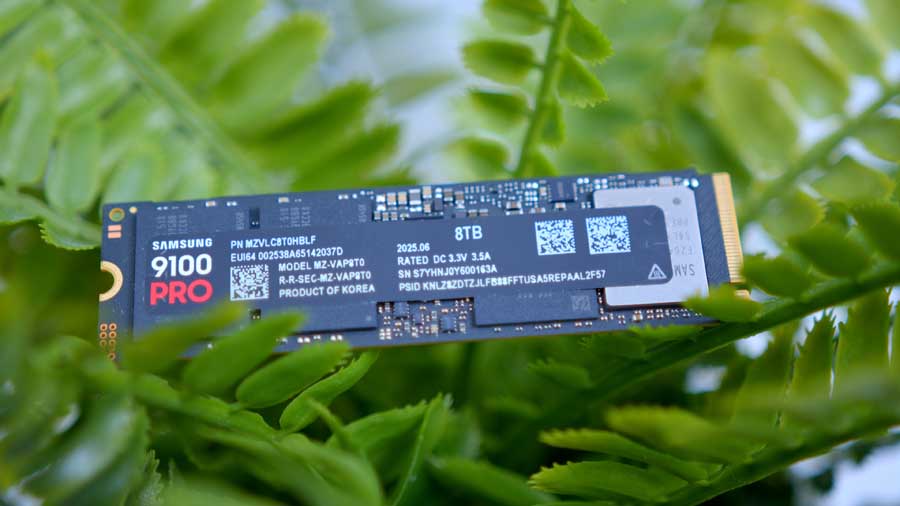
Samsung 9100 PRO 8TB
Skip to SectionSamsung’s first 8TB consumer M.2 drive and the fastest Gen 5 SSD you can buy. 14,800 MB/s reads, an 8GB DRAM cache and a 4,800TBW endurance rating.
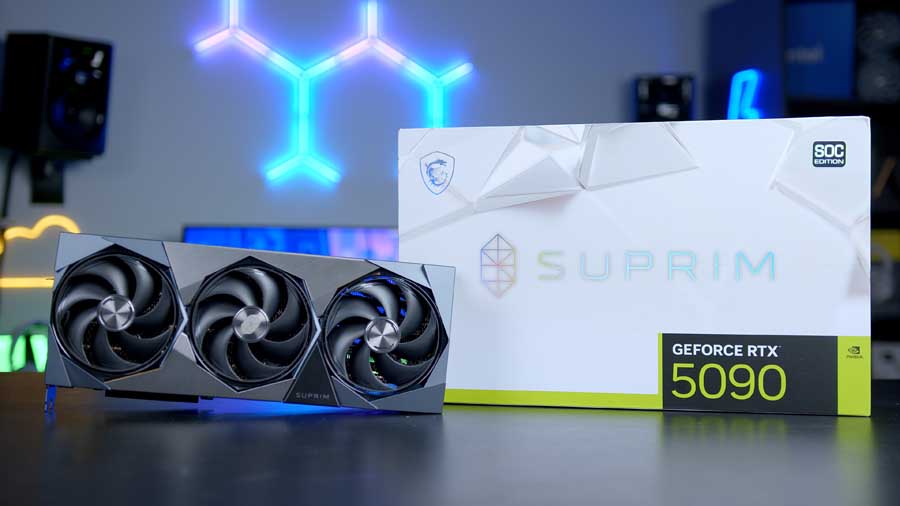
MSI GeForce RTX 5090 SUPRIM SOC
Skip to Section32GB of GDDR7 on a 512-bit bus, factory overclocked, and cooled by a four-slot Stormforce triple-fan design. This is the fastest gaming GPU money buys.
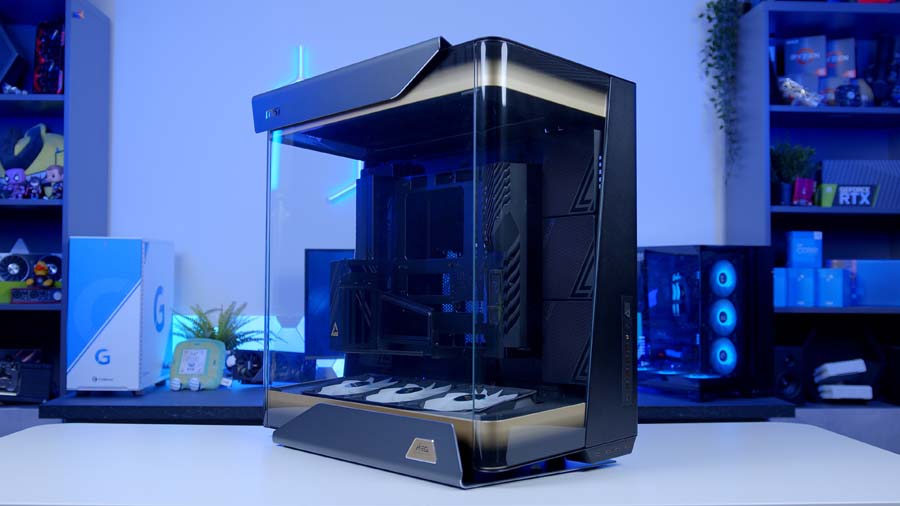
MSI MEG MAESTRO 900R
Skip to SectionA 33kg aluminium full-tower with a centred motherboard layout, triple-sided glass and a detachable tray that rotates four ways.
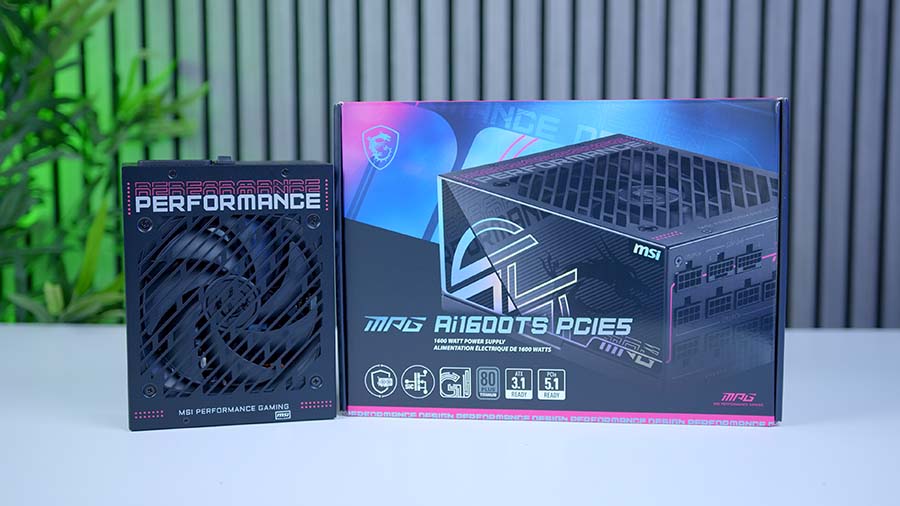
MSI MPG Ai1600TS PCIE5
Skip to Section1600W at 80 PLUS Titanium with two native 12V-2×6 connectors and GPU Safeguard+ monitoring the current on each one.
AMD Ryzen 9 9950X3D
The 9950X3D is the chip you pick when you refuse to choose between gaming and everything else. Sixteen Zen 5 cores across two CCDs, 3D V-Cache stacked on the first one, and a scheduler that parks game threads on the cache-heavy die while the second die handles the background load.
CPU Comparison
AMD Ryzen X3D Desktop CPU Comparison
Hover rows for highlight. Drag :: to reorder columns, or tap/click a header title to sort.
| ⠿ CPU | ⠿ ::Cores | ⠿ ::Threads | ⠿ ::Base Clock | ⠿ ::Max Boost | ⠿ ::TDP | ⠿ ::Total Cache | ::Where to Buy |
|---|---|---|---|---|---|---|---|
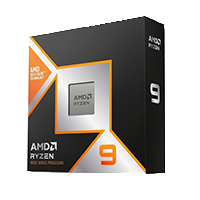
AMD Ryzen 9 9950X3D The chip in this build — Zen 5 flagship X3D |
16 | 32 | 4.3 GHz | 5.7 GHz | 170W | 144MB | |
|
AMD Ryzen 9 9900X3D 12-core Zen 5 X3D for mixed gaming and production |
12 | 24 | 4.4 GHz | 5.5 GHz | 120W | 140MB | |
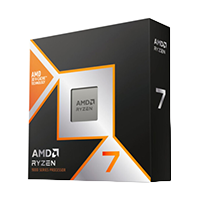
AMD Ryzen 7 9850X3D 8-core Zen 5 X3D gaming CPU |
8 | 16 | 4.7 GHz | 5.6 GHz | 120W | 104MB | |
|
AMD Ryzen 7 9800X3D High-FPS Zen 5 gaming CPU |
8 | 16 | 4.7 GHz | 5.2 GHz | 120W | 104MB | |
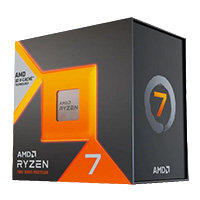
AMD Ryzen 7 7800X3D Zen 4 gaming favourite |
8 | 16 | 4.2 GHz | 5.0 GHz | 120W | 104MB |
In practice that means frame rates within touching distance of the 9800X3D, plus sixteen cores available the moment you open a render queue or a compiler. At 170W it needs proper cooling, which this build has in abundance, and it’s the only processor in AMD’s range that suits a 5090 without you wondering whether a cheaper chip would have done.
The 9800X3D and 9850X3D will match it in games for less money, and if gaming is genuinely all this machine will do, that’s the smarter buy. The argument for the 9950X3D is everything that happens when you alt-tab.
MSI MEG CoreLiquid E15 360
MSI’s flagship AIO arrives with a 6.67-inch curved AMOLED panel bolted above the pump, and it’s the part everyone will notice first. 2K resolution, a 110-degree curve, and enough brightness that it reads as a display rather than a novelty. It attaches magnetically and holds firmly, which is more than can be said for some screen-equipped coolers.
Underneath the theatre it’s a competent 360mm unit. The radiator is 30mm thick, the three 120mm fans sit in a single frame, and the middle one spins backwards to cut the turbulence between it and its neighbours. If a fan stops, the other two ramp to cover it and the lighting turns red to tell you why.
Two things to plan for. The EZ Conn single-cable design genuinely does reduce the wiring, so run it before you commit to a cable route. And on a 170W processor this is comfortably enough cooler, though the fans do get loud if you let them run to the top of their range. Build a curve rather than leaving it on auto.
MSI MEG X870E GODLIKE X EDITION
The Godlike X is MSI’s anniversary edition of an already excessive board, limited to a thousand numbered units. What you’re paying for is the removal of every ceiling. Twenty-four 110A power stages on a ten-layer PCB with dual 8-pin CPU inputs, DDR5 rated past 8400MT/s, and a 3.99-inch dashboard in the corner reporting on all of it.
Storage is where it gets silly. Five M.2 slots on the board plus a two-slot Gen 5 expansion card in the box, so seven drives without an adapter, four of them running at Gen 5 speeds. Networking is 10 gigabit and 5 gigabit Ethernet side by side with Wi-Fi 7, and the rear panel carries dual USB4 alongside enough Type-C to make you count twice.
Motherboard Specifications
- Model MSI MEG X870E GODLIKE X EDITION
- Chipset / Socket AMD X870E / AM5
- Form Factor E-ATX
- CPU Support AMD Ryzen 9000 / 8000 / 7000 Series (AM5)
- Memory Support 4 x DDR5 DIMM, dual channel, DDR5-8400+ MT/s (OC), EXPO and XMP
- VRM Design 24+2+1 Duet Rail, 110A SPS, dual 8-pin CPU power, 10-layer 2oz copper PCB
- Graphics Card Compatibility 1 x PCIe 5.0 x16 slot (with Steel Armor II and EZ PCIe Release)
- Expansion Card Compatibility 1 x PCIe 5.0 x8 slot + 1 x PCIe 4.0 x4 slot
- M.2 Compatibility 7 x M.2 total: 2 x Gen5 x4 onboard, 2 x Gen5 x4 via XPANDER-Z SLIDER card, 2 x Gen4 x4, 1 x Gen4 x2
- SATA Storage 4 x SATA 6Gb/s ports
- Networking Wi-Fi 7 + Bluetooth, Marvell 10GbE LAN, Realtek 5GbE LAN
- Rear I/O 2 x USB4 40Gbps Type-C, 1 x USB 20Gbps Type-C, 14 x USB 10Gbps, 4 x USB 5Gbps, 4 x USB 2.0
- Front I/O Headers 1 x USB 20Gbps Type-C with 60W Power Delivery, additional USB 10Gbps and USB 2.0 headers
- Audio Realtek ALC4082 with ESS9219Q combo DAC/HPA, 7.1-channel
- Display / Monitoring Dynamic Dashboard III, 3.99″ LCD for hardware monitoring and BIOS updates
- Overclocking OC Engine, Click BIOS X, Core Boost and Memory Boost
- Colour Black with crystal-cut tempered glass heatsink inlay
- Edition Notes Limited to 1,000 units with numbered golden nameplate and collector’s stand
None of this is necessary for a gaming PC and MSI knows it. The board exists to be the most complete AM5 option available, and on that measure it succeeds. If you want the same silicon without the collector’s stand, the standard X870E Godlike does most of this for less.
Corsair Dominator Titanium
Dominator Titanium is Corsair’s premium kit and it looks it. The Titanium heat spreader is machined rather than stamped, the top RGB bar is removable if you want a flatter profile, and there are eleven CAPELLIX LEDs per module doing the lighting.
Whatever speed you land on, the rule for AM5 hasn’t changed. The memory controller wants a 1:1 Infinity Fabric ratio, which caps out around 6000 to 6400MT/s on most 9000-series chips, and pushing past that drops you to a 2:1 divider that costs more in latency than it gains in bandwidth. Faster kits look better on the box and rarely play better.
Switch EXPO on in BIOS once it’s installed. Even a kit this expensive boots at JEDEC speed until you tell it not to.
Samsung 9100 PRO 8TB
Samsung’s first 8TB consumer M.2 drive, and it doesn’t give anything up to reach that capacity. 14,800 MB/s reads and 13,400 MB/s writes put it at the front of the Gen 5 field, and the 8GB LPDDR4X cache scales with the drive rather than being trimmed to hit a price.
The endurance figure is the one that stands out. 4,800TBW over a five-year warranty works out at roughly 2.6TB of writes every day before you reach the limit, which is not a number most people will trouble.
One physical note worth knowing. The 8TB model is double-sided, unlike the 1TB through 4TB versions, so it needs an M.2 slot with clearance on both faces. The Godlike X handles it, but check before you move the drive into anything smaller later on.
MSI GeForce RTX 5090 SUPRIM SOC
There’s nothing faster. 21,760 CUDA cores, 32GB of GDDR7 on a 512-bit bus, and MSI’s Suprim treatment on top with a factory overclock that lifts boost to 2,565 MHz in Gaming Mode.
The size deserves its own paragraph. At 359mm long, 150mm tall and 76mm thick, this occupies four expansion slots and weighs the better part of three kilograms. That’s a genuine load on the PCIe slot, and the reason the MAESTRO 900R ships with a vertical mount and a riser cable rather than treating them as extras.
Power is the other headline. Gaming Mode runs a 600W limit through a single 12V-2×6 connector, which is the ceiling that connector is rated for. Seat the cable fully, check it after you’ve routed everything, and don’t put a bend near the connector. The dual BIOS gives you a Silent Mode at 575W if you’d rather trade a little performance for noise.
If the 5090 is more card than the budget stretches to, this is the sensible step down.
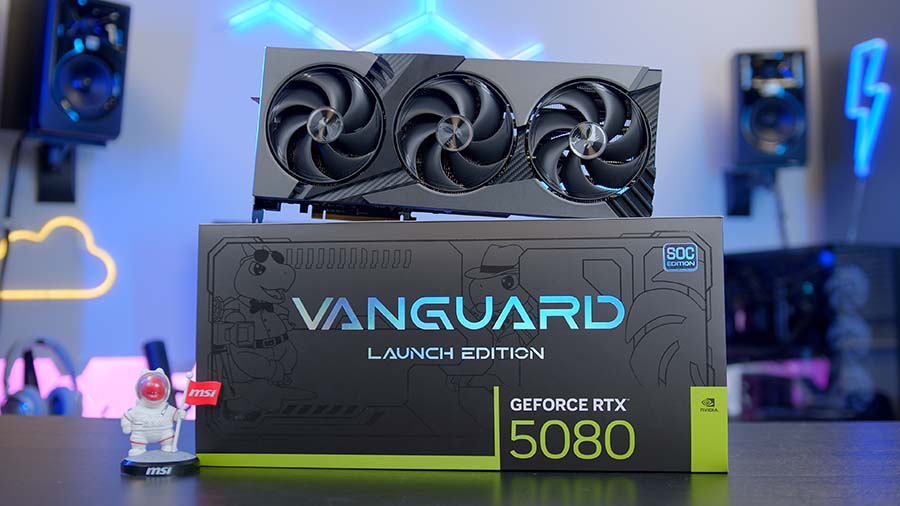
Alternative GPU Choice
NVIDIA GeForce RTX 5080
There’s nothing above the RTX 5090, so the only alternative worth naming is the one below it. The RTX 5080 keeps the same Blackwell feature set, DLSS 4 and Multi Frame Generation included, at a fraction of the outlay. You give up half the CUDA cores and drop from 32GB on a 512-bit bus to 16GB on a 256-bit one, but you also stop needing a four-slot cooler and a kilowatt-plus power supply.
MSI MEG MAESTRO 900R
The MAESTRO 900R is less a case than a display cabinet with a PC inside it. The motherboard sits in the centre of the chassis, surrounded on three sides by curved tempered glass, with 3mm CNC-machined aluminium panels making up everything that isn’t transparent.
It weighs 33kg empty. Built, you’re looking at something closer to 45kg, so decide where it’s going before it arrives rather than after. In return you get a motherboard tray that detaches and rotates four ways, which turns the awkward job of building around a 4-slot GPU into something you can do on a bench.
Case Specifications
- Model MSI MEG MAESTRO 900R
- Form Factor Full-Tower
- Motherboard Support Mini-ITX, Micro-ATX, ATX, E-ATX (up to 280 x 305mm)
- Case Dimensions (L x W x H) 695mm x 379mm x 671mm
- Front IO 4 x USB 5Gbps Type-A, 4 x USB 10Gbps Type-C, 1 x USB 20Gbps Type-C (up to 60W PD)
- PCI-E Slots Horizontal and vertical mounting, PCIe Gen 5 riser cable included
- Colour Black, CNC-machined 3mm aluminium panels
-
Max Clearance
GPU length: Up to 440mmCPU cooler: Up to 170mmPSU length: Up to 200mm
- Drive Support 8 x 2.5-inch 4 x 3.5-inch plus 1 x 2.5/3.5-inch combo bay
-
Fan Support
Total: Up to 14 x 120mmBottom: 3 x 160mm (pre-installed)Top: Up to 420mm arraySides: Up to 3 x 120mm per side
-
Radiator Support
Top: Up to 420mmBottom: Up to 420mmLeft / Right of tray: Up to 360mm each
- Pre-Installed Fans 3 x 160mm reverse-blade ARGB (bottom intake)
- Special Features Detachable 4-way rotatable motherboard tray, triple-sided panoramic glass, vertical GPU bracket
- Weight Approximately 33kg empty
Cooling capacity is far beyond what this parts list needs. Fourteen fan mounts, dual 420mm radiator support top and bottom, and 360mm positions on both sides of the tray, which is custom-loop territory rather than AIO territory. The three 160mm intakes at the base push air upward through the GPU first, then the CPU, then out of the top.
Storage support is unusually generous too, with eight 2.5-inch bays and four 3.5-inch, plus a combo bay. On a build with an 8TB NVMe drive that’s academic, but it’s there if this doubles as a workstation.
MSI MPG Ai1600TS PCIE5
1600W at 80 PLUS Titanium, with almost all of it available on the 12V rail. Against a 600W graphics card and a 170W processor that’s roughly double what the system will draw, which sounds absurd until you remember that a 5090’s transient spikes are what actually trips a marginal supply.
The feature that justifies the badge is GPU Safeguard+. It monitors current on each 12V-2×6 socket individually and raises an alert through MSI Center if a pin drifts outside the range you’ve set, with Afterburner able to pull the GPU power limit down to 75% in response. Given how much of the last two years of GPU discussion has been about that connector, having the power supply watch it is genuinely useful.
From Our Full Review
★★★★☆
4.6/5

Pros and Cons
Pros
- Revolutionary Safeguard+ tech
- Dual 12V-2×6 support
- 80 Plus Titanium efficiency
Cons
- Overkill for mainstream builds
- 190mm length requires spacious case
- Heavy unit weight
Bottom Line
Flagship-tier performance without the flagship badge. The Ai1600TS undercuts MSI’s own MEG Ai1600T while adding GPU Safeguard+, and between dual 12V-2×6 connectors, Titanium efficiency and 1600W on a single rail it has more than enough in hand for an RTX 5090. Overkill for mainstream builds, which is rather the point of this one.
Read The Full ReviewTwo practical notes. It’s 190mm long, so it’s longer than a standard ATX unit, and the MAESTRO 900R’s 200mm allowance leaves you 10mm plus whatever the cables need. And it uses a C19 mains inlet rather than the usual kettle lead, so the cable that came with your old PSU won’t fit.
MSI MPG 322UR QD-OLED X24
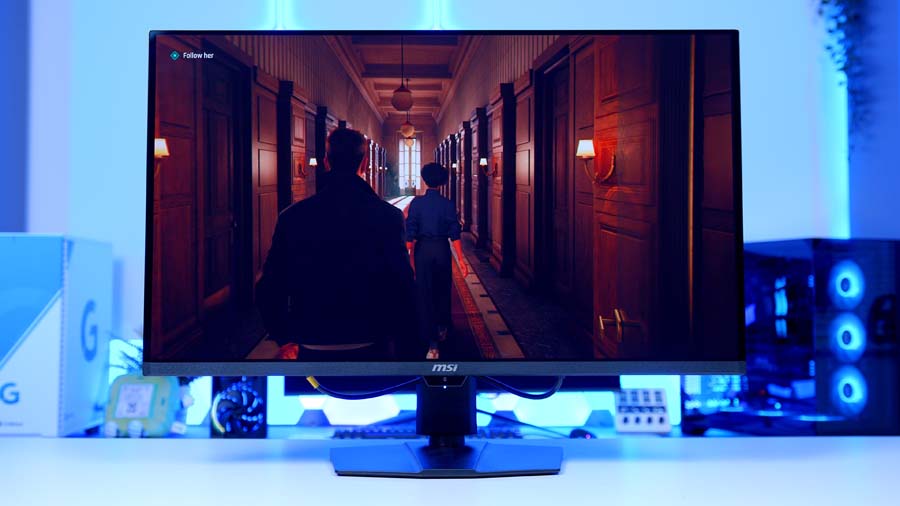
A 5090 deserves a screen that can keep up with it, and the 322UR QD-OLED X24 is the one to put in front of this build. 4K at 240Hz on a 31.5-inch QD-OLED, with a 0.03ms response time and per-pixel lighting that gives you the black levels no backlit panel can match.
The panel is the fourth-generation Tandem QD-OLED, which stacks five light-emitting layers to lift efficiency by around 30%. In practice that means DisplayHDR True Black 500 certification rather than the 400 most QD-OLEDs carry, a 1,000 nit peak, and higher full-screen brightness than earlier generations managed. MSI’s DarkArmor film sits on top of it, cutting the magenta tint QD-OLED picks up under room lighting and deepening blacks by a claimed 40%.
The connection matters as much as the panel here. DisplayPort 2.1a with full UHBR20 bandwidth carries 4K at 240Hz without display stream compression, which the 5090 can actually saturate. Both HDMI 2.1 ports run the same resolution and refresh, and the USB-C input adds 98W of power delivery alongside a KVM switch, so a laptop can share the screen on one cable.
Panel care is handled by the AI Care Sensor, which watches for your presence and dims or blanks the screen when you step away, plus the wider OLED Care 3.0 suite. Burn-in is covered by the three-year warranty, which is the reassurance that makes an OLED sensible as a primary display rather than a luxury.
Gaming Performance
Nothing in the test set troubles it. Six games at 4K High and the slowest average is 109.5fps, which says more about the games than the hardware. Forza Horizon 6 runs at 205.4fps and Arc Raiders at 183.4, both well past what any 4K panel will show you. Marvel Rivals sits at 134.9 and Battlefield 6 at 151, while the two heaviest titles in the group, Cyberpunk 2077 and 007 First Light, land at 110.3 and 109.5. That’s a 149fps average across the six, all of it native 4K with upscaling and frame generation switched off.
Performance Snapshot · 4K High
Multi-Game Average FPS · Ryzen 9 9950X3D + RTX 5090
4K HIGH
109.5FPS
4K HIGH
183.4FPS
Map
Dam Battlegrounds
Capture Length
4–7 mins
Window Mode
Fullscreen
Resolution Scaling
TAAU, 100% (3840×2160), Manual
Frame Generation
Off
VSync
Off
Overall Quality
High
Graphics Breakdown
View Distance / AA / Shadows / Post / Texture / Effects / Reflections / Foliage / GI all High
4K HIGH
151.0FPS
Map / Mode
Empire State, Conquest
Capture Length
4–7 mins
Fullscreen Mode
Windowed (Fullscreen Device Monitor 1)
Resolution / Refresh
3840×2160, 120Hz, Aspect Auto
VSync / FOV
VSync Off, FOV 90, Vehicle FOV 79
Preset
Custom, Graphics Quality High
Texture / Mesh / Terrain
All High
Reflections / AO & GI
Reflections High, SSR High, GTAO High
4K HIGH
110.3FPS
Benchmark Mode
Built-in benchmark ran 2x
Display
Fullscreen, 3840×2160, VSync Off, FPS cap Off
Preset
Custom, Texture High
Upscaling / Frame Gen
Resolution Scaling Off, Frame Generation Off
Ray Tracing / Path Tracing
All Off
Crowd / FOV
Crowd Density Medium, FOV 80
Post Effects
Film Grain On, DoF On, Lens Flare On, Motion Blur Off
Shadow Quality
Local Shadow Mesh High, Local Shadow High, Cascaded range/resolution High
4K HIGH
205.4FPS
4K HIGH
134.9FPS
Capture Length
4–7 mins
Display
Fullscreen, 3840×2160, Aspect 16:9
AA / Upscaling
TAAU, Render Scale 100
Frame Gen / Latency
Frame Generation Off, Low Latency Off
VSync / FPS Cap
VSync Off, Match/Lobby/Background FPS No Limit
Preset
Graphics Quality High
GI / Reflections
Lumen GI High Quality, SSR Reflections
Detail Settings
Model / Post / Shadows / Texture / Effects / Foliage all High
The lows are where it gets more interesting. Forza holds together best, with a 129.2fps 1% low and 99.6 at the 0.1% mark, so it’s smooth the whole way through. Battlefield 6 goes the other way: 151fps average against a 19.1fps 0.1% low, which points at traversal and streaming rather than a shortage of GPU. 007 First Light does something similar at 47.6 and 23.1. Switching DLSS on lifts the averages in both, but dips like those tend to stay roughly where they are.
Final Thoughts
There’s no value argument to make here and it would be dishonest to try. This is a parts list assembled without a ceiling, and the price reflects every decision in it.
What it does is remove every excuse. The processor won’t hold the graphics card back, the graphics card is the fastest available, the storage is the quickest consumer drive on sale, and the power supply has enough in reserve to run the next one too. If that’s what you’re after, this is what it looks like.