
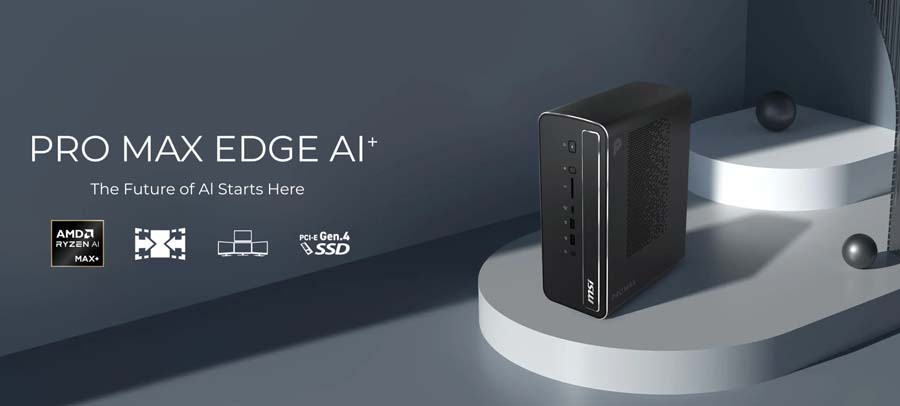
MSI’s taking its PRO MAX business range somewhere a bit different. The new PRO MAX Edge AI+ is a 4-litre mini PC built around AMD’s Ryzen AI Max+ 395 and a whopping 128GB of unified memory, and it’s aimed squarely at businesses that want to run large language models (LLMs) on their own hardware instead of sending sensitive data off to the cloud. It goes on sale in the UK on 1st October, with Scan as the launch retailer.
What’s Under the Hood
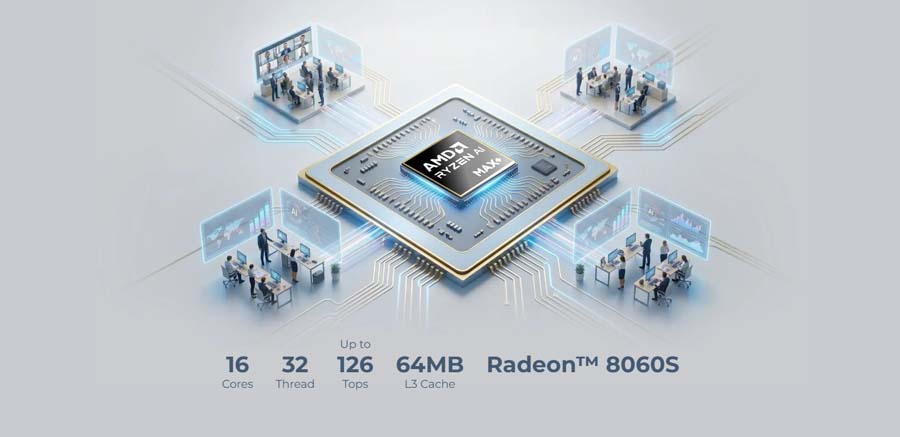
The chip doing the heavy lifting is AMD’s Ryzen AI Max+ 395, the top model in the Strix Halo family. You’re getting 16 Zen 5 cores and 32 threads, 64MB of L3 cache and a boost clock of up to 5.1GHz, alongside Radeon 8060S integrated graphics built on RDNA 3.5. There’s no discrete graphics card in here at all, and for this kind of machine that’s deliberate.
Memory is where things get interesting. The 128GB of LPDDR5X runs at 8000 MT/s and sits on the processor package, so there’s no upgrading it later, but up to 96GB of that pool can be handed over to the GPU as video memory (VRAM). For AI work, that’s the whole point. Even the biggest consumer graphics cards top out well short of that figure, and VRAM capacity is usually the wall you hit first when trying to load a large model locally.
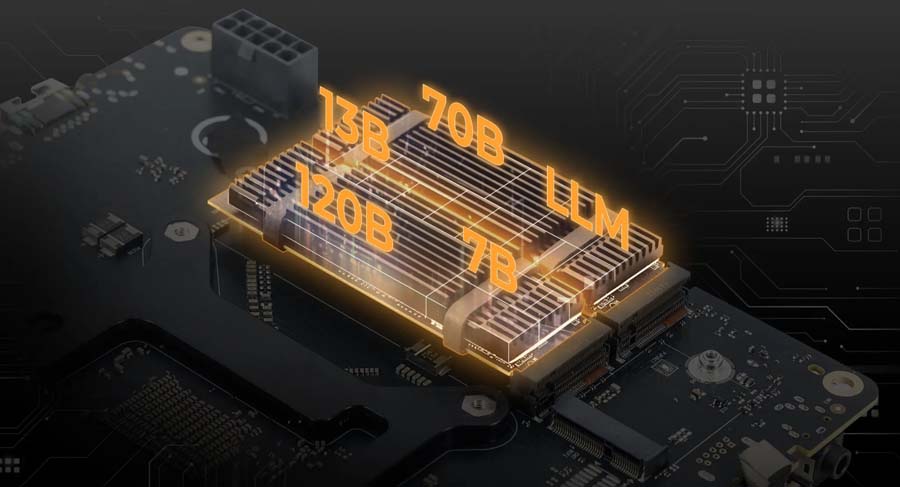
Storage comes as a 2TB PCIe 4.0 NVMe solid-state drive (SSD), and there’s a second M.2 2280 slot free if you want to keep a library of models on a separate drive. The UK configuration ships with Windows 11 Pro, qualifies as a Copilot+ PC, and MSI backs it with a three-year warranty.
Built for Local AI
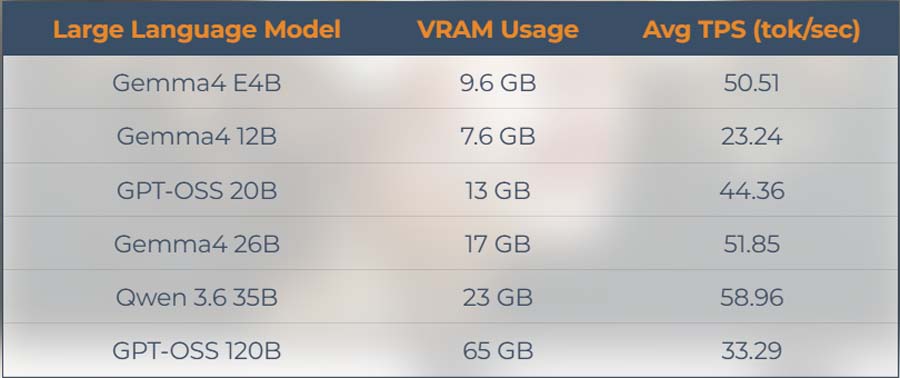
MSI’s pitch leans hard on running big models completely offline. The company says the Edge AI+ can handle models of up to 120 billion parameters without touching the internet, and its own testing puts OpenAI’s GPT-OSS 120B at around 33 tokens per second while using 65GB of VRAM. Smaller models such as GPT-OSS 20B and Qwen 3.6 35B come in at roughly 44 and 59 tokens per second respectively, again by MSI’s numbers.

AMD and MSI quote up to 126 trillion operations per second (TOPS) of combined AI performance across the CPU, GPU and neural processing unit (NPU). The NPU accounts for 50 TOPS of that on its own, comfortably clearing Microsoft’s bar for Copilot+ features.
There’s a scaling angle too. MSI says several units can be clustered together to run models too large for one machine, listing examples up to DeepSeek V3.1 at 671 billion parameters spread across four nodes. That’s a niche use case, but it’s a smart one for small studios and research teams who’d otherwise be looking at server hardware.
It’s worth noting MSI’s own press release is careful on the privacy front. Keeping data on the device helps, but how much control you actually retain still depends on the software you run and how you deploy it. Local hardware is the starting point, not the whole answer.
Chassis, Cooling and Connectivity
The 4-litre chassis is aluminium, finished with fine sandblasting and diamond-cut detailing, and MSI has squeezed a 300W power supply inside it. No external power brick is a nice touch on a machine this size, and it keeps the desk down to a single mains lead.
Cooling falls to MSI’s Frozr AI Pro setup, which pairs a copper heat spreader and three heat pipes with a triple-fan arrangement, plus Glacier Armor heatsinks on the SSDs. MSI claims near-silent running under sustained load, which is something we’d want to hear for ourselves before taking at face value. There’s also a physical three-stage performance switch on the front, letting you flip between power profiles without opening any software.
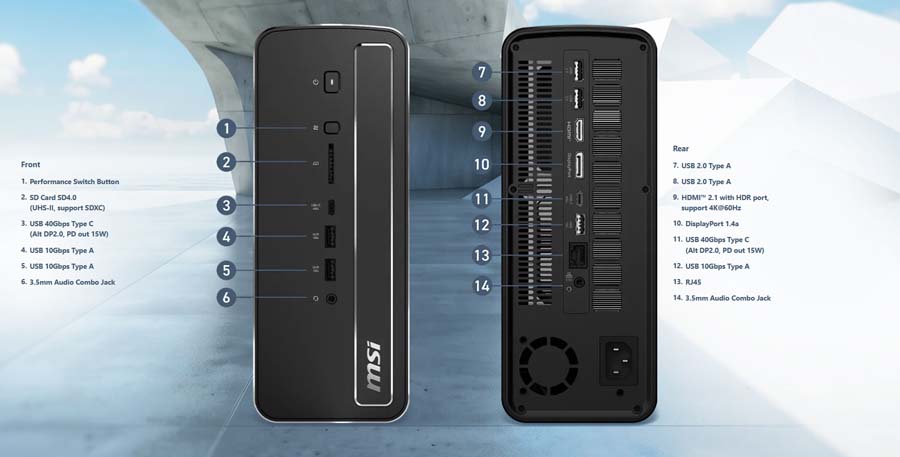
Connectivity is generous for the footprint. Up front you get an SD 4.0 card reader with UHS-II support, a 40Gbps USB Type-C port, two 10Gbps USB Type-A ports and a headset jack. Round the back sits a second 40Gbps Type-C port, another 10Gbps Type-A, two USB 2.0 ports, HDMI 2.1, DisplayPort 1.4a, 2.5Gb Ethernet and another audio jack. Both Type-C ports carry DisplayPort 2.0 Alt Mode and 15W power output, which is how it reaches four independent displays. Wi-Fi 7 and Bluetooth 5.4 round things off, with a Kensington lock slot and a discrete Trusted Platform Module (TPM) for the IT department.
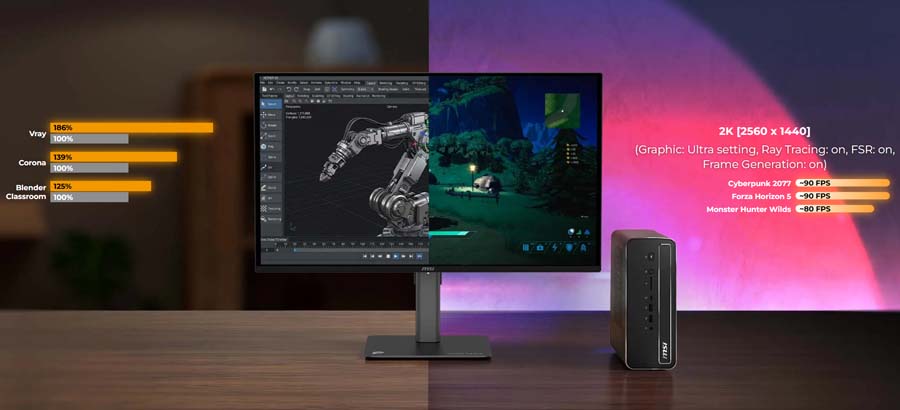
And yes, it’ll game. MSI quotes roughly 80 to 90fps at 1440p on ultra settings with ray tracing in Cyberpunk 2077, Forza Horizon 5 and Monster Hunter Wilds, though that’s with FSR upscaling and frame generation switched on, so treat those numbers with a pinch of salt.
Pricing and Availability
The PRO MAX Edge AI+ is available from Scan from 1st October in a single configuration: Ryzen AI Max+ 395, 128GB of memory, a 2TB SSD and Windows 11 Pro. It’s firmly priced as a professional workstation, well above what you’d pay for a typical mini PC, and Scan is already running a launch discount off MSI’s recommended price.