
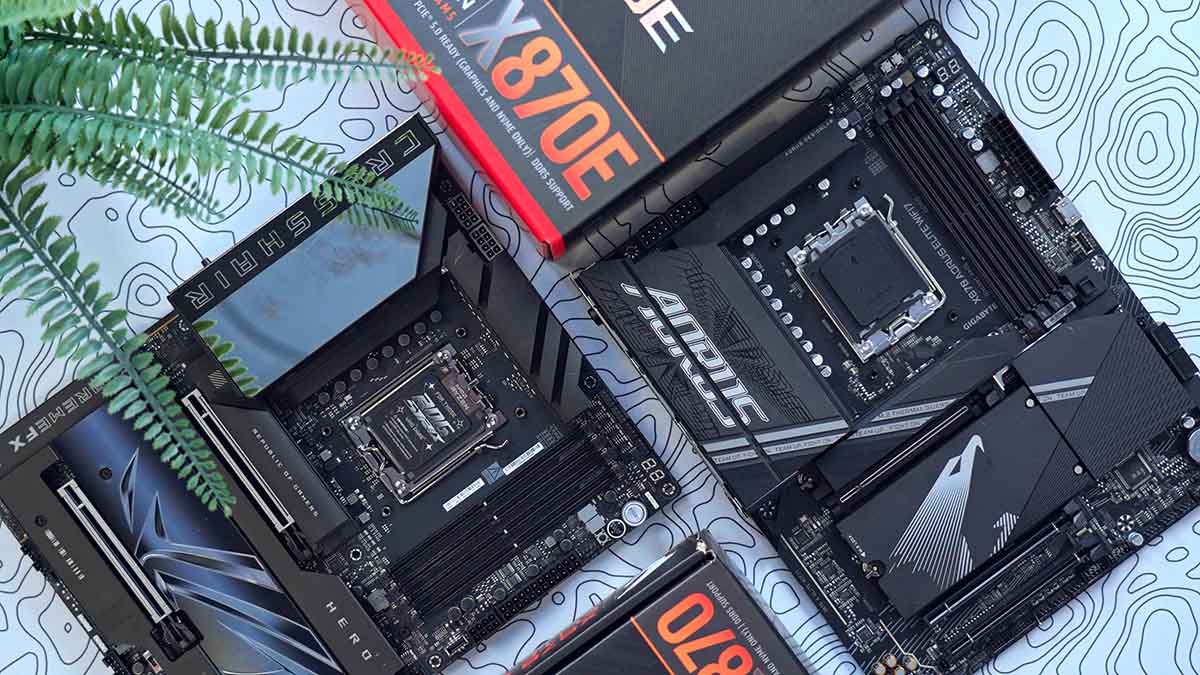
Launched in November 2024, the AMD Ryzen 7 9800X3D instantly claimed its spot as one of the fastest gaming CPUs on the market. Powered by AMD’s 3D V-Cache technology, it delivers a clear performance uplift over its predecessor, boosted clock speeds, and a newfound ability to overclock, a first for any ‘3D’ chip. But raw power is only half the story. To unlock the full potential of the 9800X3D, you’ll need the correct motherboard, and with so many X870 and X870E options (plus SKU refreshes since launch), choosing the best fit can feel overwhelming. That’s where we come in!
We’ve tested a wide range of boards across different budgets and configurations, analysing each board’s specs, design, and pricing, providing an overview of our chosen options. This guide highlights the standout choices that pair perfectly with the Ryzen 7 9800X3D, whether you’re building a high-end gaming rig or a balanced workstation.
The Best Motherboards for the Ryzen 7 9800X3D
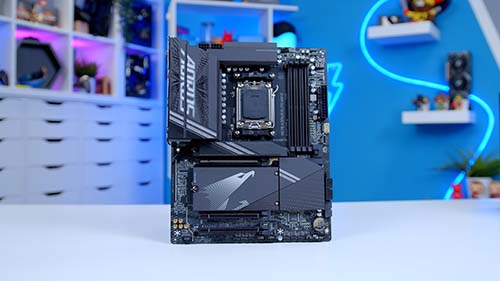
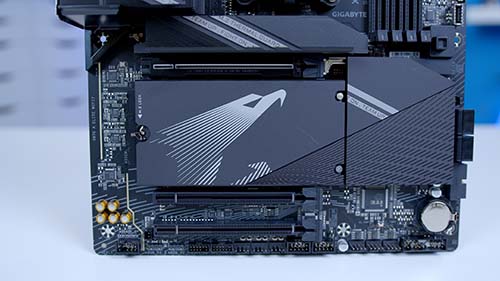
1. Gigabyte X870 AORUS Elite WiFi7

The first motherboard we are recommending is the Gigabyte X870 AORUS Elite WiFi7. This mid-range ATX board is geared towards gamers who want to minimise their build expenditure. The X870 AORUS Elite WiFi7 is slightly more barebones than other boards, meaning fewer heatsinks cover the rugged PCB underneath. However, this board still offers a decent aesthetic that will appeal to some.
Looking at expansion, this board offers a single Gen5 graphics card slot, three Gen5 M.2 SSD slots, and one Gen4 slot. It’s pretty impressive that this board has four Gen5 slots (one for your graphics card and three M.2 slots), especially since most other options support only one or two. RAM overclocking support is stronger than on most boards, with the X870 AORUS Elite supporting 8200 MT/s speeds.
| Specification | Gigabyte X870 AORUS Elite WiFi7 |
|---|---|
| Form Factor | ATX |
| Supported Memory | 256GB DDR5 8200 MT/s |
| PCI-E x16 Slots | 1 x PCI-E 5.0 1 x PCI-E 4.0 |
| PCI-E x4 Slots | 3 x PCI-E 5.0 1 x PCI-E 4.0 |
| VRM Power Phases | 16 + 2 + 2 |
| Front IO | 1 x USB 3.2 Gen2x2 Type-C 1 x USB 3.2 Gen1 Type-A 2 x USB 2.0 |
| Rear IO | 2 x USB4 Type-C 4 x USB 3.2 Gen1 Type-A 4 x USB 2.0 2 x USB 3.2 Gen2 Type-A |
| Audio | 1 x Optical S/PDIF 2 x Audio Jacks |
| Networking | 2.5 GbE LAN WiFi 7 |
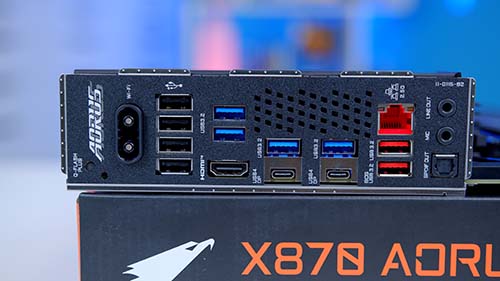
Moving onto IO, the X870 AORUS Elite is slightly weaker than the alternatives. There are twelve ports on the rear, eight of which are high-speed and four are USB 2.0. While the number of ports on this board is pretty substantial, the appearance of USB 2.0 is disappointing, and we’d much rather have some additional high-speed USB 3.0 ports. Despite this, the rest of the IO is solid. There’s a 2.5 Gigabit LAN port and WiFi 7 for networking, and the inclusion of USB4 Type-C is a welcome addition on this cheaper motherboard.
The aesthetic of the Gigabyte X870 AORUS Elite WiFi7 is its biggest weakness. While I can appreciate that there have been sacrifices made to the design, likely to improve cost, the style won’t appeal to everyone.
Suggested article: Gigabyte X870 AORUS Elite WiFi7 Review
2. MSI MPG X870E Carbon WiFi

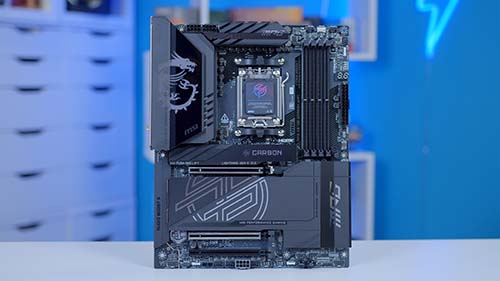
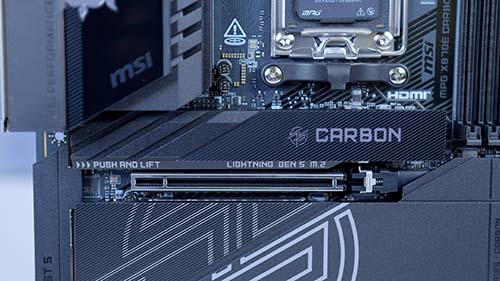
Next is the MSI MPG X870E Carbon WiFi, a slightly higher-end option than the previous Gigabyte X870 board. The MPG X870E Carbon WiFi is primarily aimed at builds that require top-end performance. This is a blacked-out X870E motherboard with dark heatsinks and a black PCB. All the heatsinks are entirely tool-less, making installing or removing SSDs and graphics cards incredibly easy. Overall, the aesthetic of this board is simple but sophisticated, blending seamlessly with black components.
This board features strong overclocking for CPUs and RAM. Enthusiasts can leverage the 18+2+1 VRM power configuration, ideal for maintaining a solid overclock, while RAM can be pushed to 8400 MT/s. In terms of expansion, there are two Gen5 graphics card slots, two Gen5 SSD slots, and two Gen4 SSD slots. So, across the board, there’s widespread support for PCI-E 5.0 and plenty of space for extra storage.
| Specification | MSI MPG X870E Carbon WiFi |
|---|---|
| Form Factor | ATX |
| Supported Memory | 256GB DDR5 8400 MT/s |
| PCI-E x16 Slots | 2 x PCI-E 5.0 1 x PCI-E 4.0 |
| PCI-E x4 Slots | 2 x PCI-E 5.0 2 x PCI-E 4.0 |
| VRM Power Phases | 18 + 2 + 1 |
| Front IO | 2 x USB 2.0 2 x USB 3.2 Gen1 Type-A 1 x USB 3.2 Gen2x2 Type-C |
| Rear IO | 2 x USB4 Type-C 9 x USB 3.2 Gen2 Type-A 2 x USB 3.2 Gen2 Type-C |
| Audio | 1 x Optical S/PDIF 2 x Audio Jacks |
| Networking | 5 GbE LAN 2.5 GbE LAN WiFi 7 |
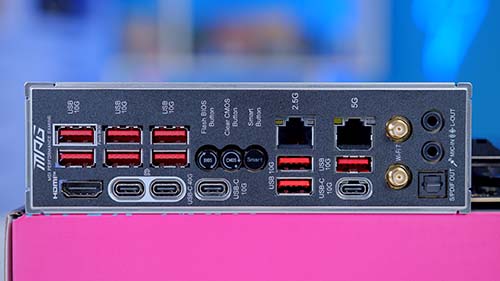
On the rear IO, there are thirteen ports. These comprise two USB4 Type-C ports, nine USB 3.2 Gen2 Type-A ports, and two USB 3.2 Gen2 Type-C ports, so there’s absolutely no USB 2.0 in sight, which is great to see. Networking is also excellent, offering prospective buyers the choice between high-speed dual LAN ports (5 Gigabit and 2.5 Gigabit) or WiFi 7 for those with a supported router.
The MSI MPG X870E Carbon WiFi’s most notable weakness is its price. This is one of the more expensive X870 motherboards on the market and will be out of reach for most prospective buyers. However, if you’re willing to spend a bit extra on your motherboard, the MPG X870E Carbon WiFi is worth considering.
Suggested article: MSI MPG X870E Carbon WiFi Review
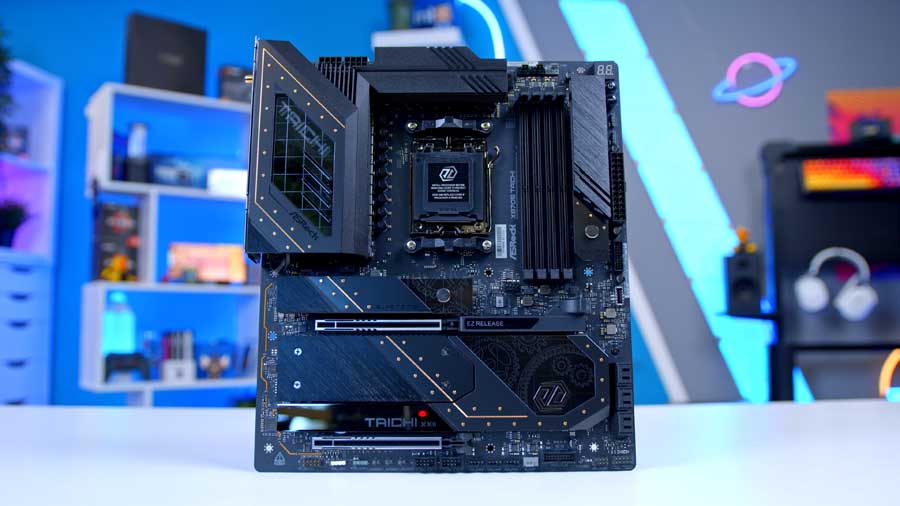
3. ASRock X870E Taichi
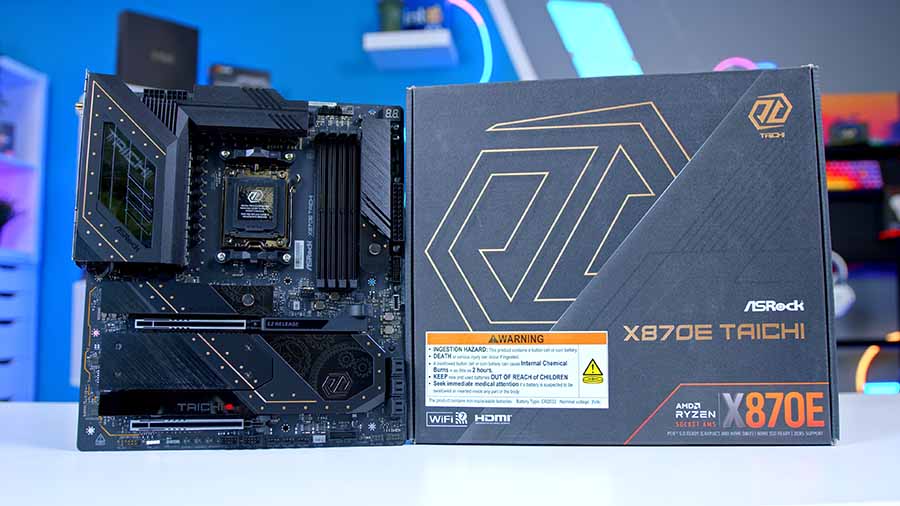
Moving on to the third motherboard recommendation, we present the ASRock X870E Taichi. This is a high-performance motherboard that offers a robust foundation for Ryzen series 7000 through to 9000 processors. This motherboard supports dual-channel RAM configurations with a maximum capacity of 256GB, and RAM speeds up to 8200 MT/s with overclocking. With its 24 + 2 + 1 power phases, it provides strong overclocking support, perfectly complementing the Ryzen 7 9800X3D processor. It is DIY-friendly by design; the Taichi is built for CPU overclocking with an extra-large VRM heatsink for efficient heat dissipation. Heavy-duty aluminium heatsinks are spread across the board, ensuring thermal performance is a priority. The vibrant RGB accents are fully compatible with ASRock Polychrome Sync, giving users versatile control over lighting effects and colour coordination.
| Specification | ASRock X870E Taichi |
|---|---|
| Form Factor | E-ATX 12.0″ x 10.5″ | 30.5 cm x 26.7 cm |
| Supported Memory | 256 GB DDR5, 8200 MT/s (OC), Dual Channel Support |
| PCI-E x16 Slots | 2 × PCI-E 5.0 1 × PCI-E 4.0 |
| PCI-E x4 Slots | 1 × PCI-E 5.0 3 × PCI-E 4.0 |
| VRM Power Phases | 24 + 2 + 1 |
| Front IO | 1 × USB 3.2 Gen2x2 Type-C 4 × USB 3.2 Gen1 Type-A 4 × USB 2.0 Type-A |
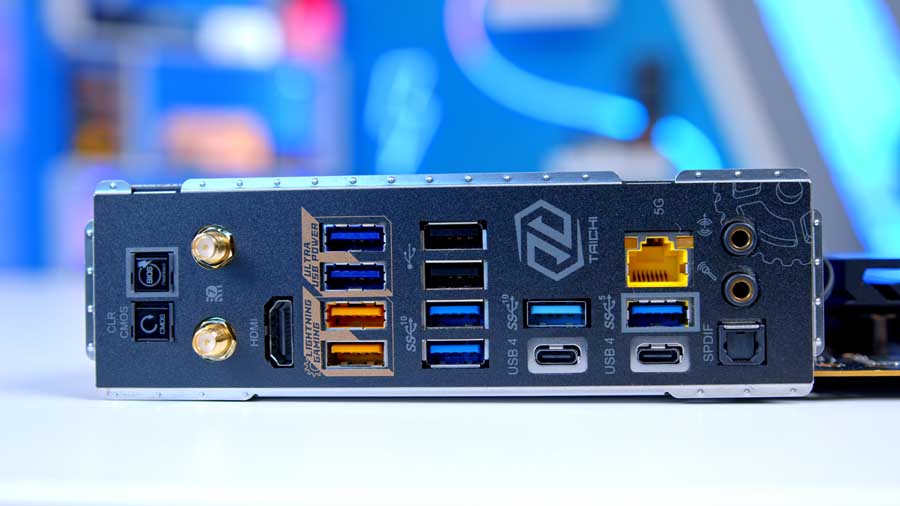
| Rear IO | 2 × USB4 Type-C 5 × USB 3.2 Gen2 Type-A 3 × USB 3.2 Gen1 Type-A 2 × USB 2.0 Type-A |
| Audio | 1 x Optical S/PDIF 1 x Microphone Input Jack 1 x Line Out Jack |
| Networking | 5 GbE LAN WiFi 7 |
In terms of PCIe lanes, the X870E Taichi can accommodate two graphics cards at PCIe Gen5, with slots thoughtfully spaced to account for the size of modern GPUs. Storage expansion is equally impressive: the board supports four M.2 drives, one using the latest PCIe Gen5 x4 lanes, and the other three using PCIe Gen4, all offering blazing speeds for demanding workloads.
On the rear IO, the Taichi delivers an abundance of connectivity. It offers eight USB Type-A ports, ranging from legacy USB 2.0 to USB 3.2 Gen 2, ensuring compatibility with both older peripherals and high-speed devices. In addition, it features USB4 Type-C for next-generation transfer rates and versatile device support, making it ideal for creators and power users who rely on fast external storage or docking solutions. Networking is equally forward-looking, with a 5GbE LAN port for ultra-fast wired connections and onboard WiFi 7 for cutting-edge wireless performance.
Overall, the ASRock X870E Taichi is a thermal-optimised, feature-rich motherboard that balances overclocking headroom, versatile connectivity, and vibrant aesthetics. For builders pairing with the Ryzen 7 9800X3D, it provides a stable, high-performance platform that’s ready to push boundaries in both gaming and productivity.

4. ASUS ROG CROSSHAIR X870E HERO
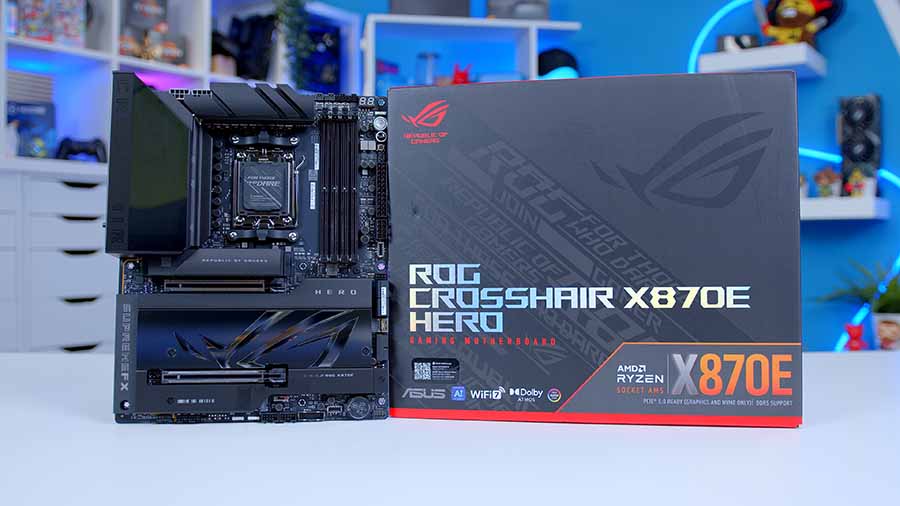
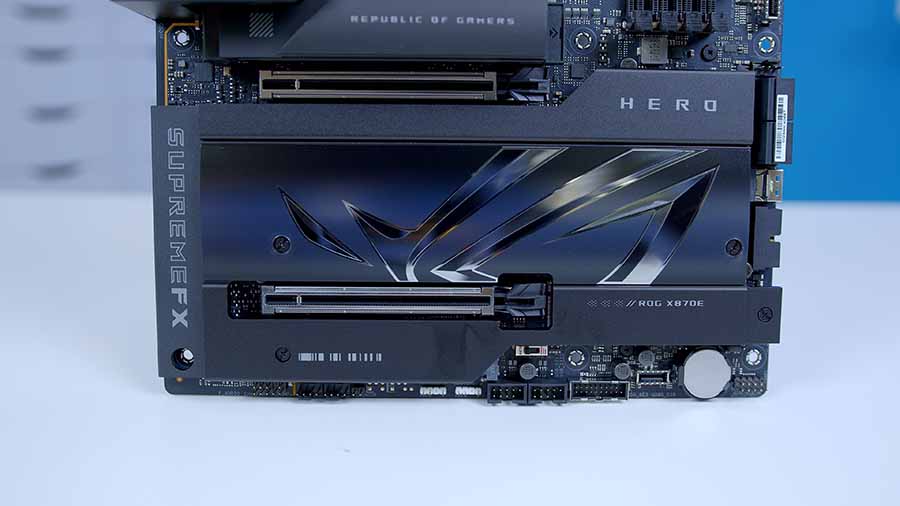
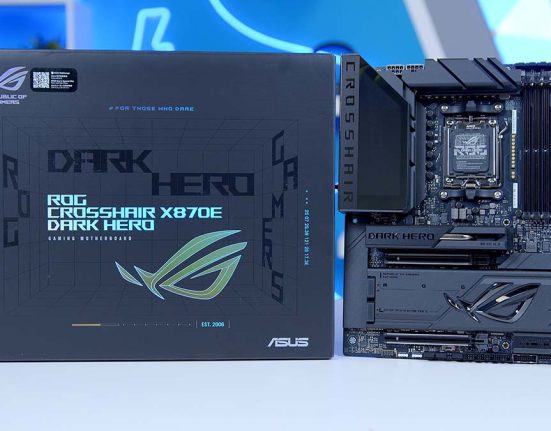
Our final recommendation for this Buyer’s Guide roundup is the ASUS ROG CROSSHAIR X870E HERO motherboard. During our testing of this motherboard, we concluded that it deserved our enthusiast award because it genuinely is an enthusiast-level motherboard designed to offer builders the best of the best in features, connectivity, expansion, and sheer performance. The ROG CROSSHAIR X870E HERO even delivers in the killer aesthetic departments, featuring sultry dark hues across the board with premium accents such as metallic textures, nickel-plated surfaces, sleek contours and a stereoscopic visual effect on the large M.2 and chipset heatsink.
The ROG CROSSHAIR X870E HERO comes with onboard AI to help you tweak and tune your components to the optimal levels for your setup. The AI can aid CPU overclocking, improve your system’s thermals and acoustics, and optimise your networking performance. It is a motherboard engineered to unleash the performance of AMD Ryzen 9000 Series processors, with unyielding power delivery via 18 + 2 + 2 power phases and robust thermal solutions, including its integrated VRM and aluminium IO heatsink, which even comes equipped with a vibrant RGB ROG logo.
| Specification | ASUS ROG CROSSHAIR X870E HERO |
|---|---|
| Form Factor | ATX |
| Supported Memory | 256 GB DDR5, 8600 MT/s (OC) |
| PCI-E x16 Slots | 2 x PCI-E 5.0 |
| PCI-E x4 Slots | 3 x PCI-E 5.0 2 x PCI-E 4.0 |
| VRM Power Phases | 18 + 2 + 2 |
| Front IO | 2 x USB 3.2 Gen2x2 Type-C 2 x USB 3.2 Gen1 Type-A 2 x USB 2.0 |
| Rear IO | 2 x USB 10Gbps Type-C 2 x USB4 40Gbps Type-C 6 x USB 10Gbps Type-A |
| Audio | 1 x Optical S/PDIF 2 x Audio Jacks |
| Networking | 2.5 GbE LAN 5 GbE LAN WiFi 7 |
Memory support is another standout feature. The HERO can support up to 256 GB of DDR5 RAM, with overclocked speeds up to 8600 MT/s. This makes it ideal for builders who want to push the limits of next-gen memory modules. Expansion is equally impressive, with dual PCIe 5.0 x16 slots for graphics cards and multiple PCIe 5.0 and 4.0 slots for additional devices. Storage flexibility is a highlight too, with several M.2 slots, three of them being PCIe, allowing for blistering SSD speeds that are perfect for gaming, content creation, or workstation use.
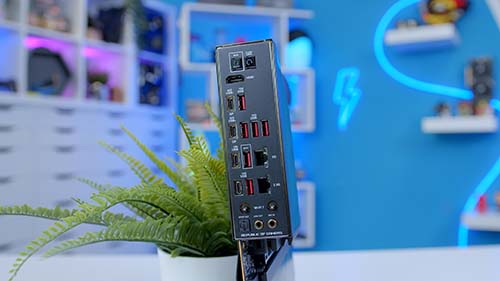
Connectivity is where the HERO really flexes its enthusiast credentials. The rear IO is stacked with options, including dual USB4 Type-C ports capable of 40Gbps transfer speeds, additional USB 10Gbps ports, and six USB 10Gbps Type-A ports. Networking is also advanced, with dual LAN (2.5 GbE and 5 GbE) and Wi-Fi 7, ensuring ultra-fast, reliable connections whether wired or wireless. The front panel I/O also supports high-speed USB-C with Quick Charge, making it practical for modern devices. Overall, we felt that the only real shortcomings with the motherboard were its lack of higher-end audio on the rear IO and the lack of a tool-less mechanism for the large heatsink.
Suggested article: ASUS ROG CROSSHAIR X870E HERO Review