
You don’t need us to tell you that memory and storage prices have gone through the roof. The AI boom has pulled an enormous share of the world’s NAND and DRAM production towards data centres, and with the big three manufacturers reallocating wafer capacity to higher margin products, everything downstream has been left fighting over what’s left. Consumer SSDs have taken a heavy hit as a result, and there’s little sign of meaningful relief until new fab capacity arrives. Seen in that light, the Samsung 990 makes a lot of sense: rather than another flagship Gen 5 drive chasing headline numbers, this is a PCIe 4.0 SSD built around what Samsung calls the sweet spot, prioritising efficiency, endurance and a price that mainstream builders might actually stomach.
That’s the pitch, at least. The question is whether a Gen 4 drive still earns a place in a system in 2026, particularly when it’s arriving without the DRAM cache and the five-year warranty that we’ve come to expect from Samsung’s better drives.
We’ve got the 1TB version in office, so in this review we’re going through the specs, the design and the feature set, before putting it through our benchmarks to see where it lands.
Specifications
SSD Specifications
- Model Samsung SSD 990 1TB (MZ-V9V1T0)
- Capacity Reviewed 1TB
- Interface PCIe 4.0 x4, NVMe 2.0
- Form Factor M.2 2280
- Controller Samsung in-house controller
- NAND / Cache Samsung V-NAND, HMB (Host Memory Buffer)
-
Sequential Read
1TB: Up to 7,150 MB/s2TB: Up to 7,250 MB/s
- Sequential Write Up to 6,450 MB/s (1TB and 2TB)
-
Random Read
1TB: Up to 700K IOPS2TB: Up to 850K IOPS
-
Random Write
1TB: Up to 1,100K IOPS2TB: Up to 1,200K IOPS
-
Power (Active, Avg)
Read: 4.0W (1TB), 4.3W (2TB)Write: 3.7W (1TB), 3.8W (2TB)
- Power (Idle, Typical) 55mW (PS3, APST on), 3mW (PS4, L1.2)
- Endurance (TBW) 400TB (1TB), 800TB (2TB)
- MTBF 1.5 million hours
- Data Security AES 256-bit full disk encryption, TCG/Opal V2.0, Encrypted Drive (IEEE1667)
- Warranty 3 years limited or TBW, whichever comes first
Design
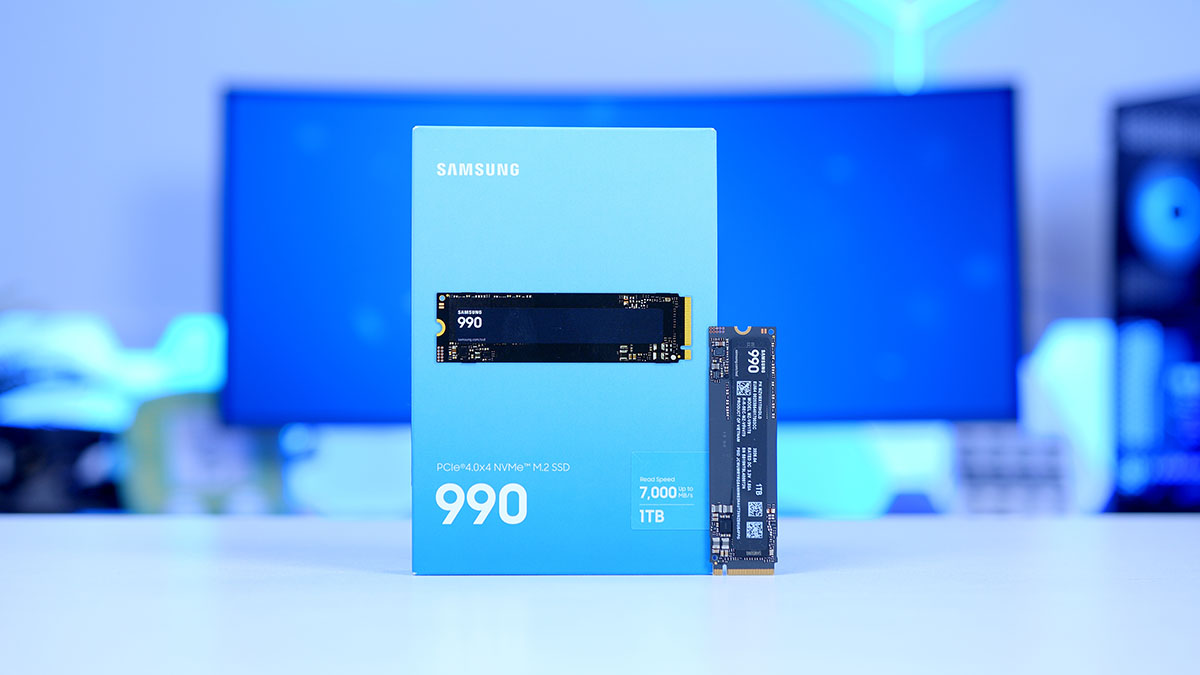
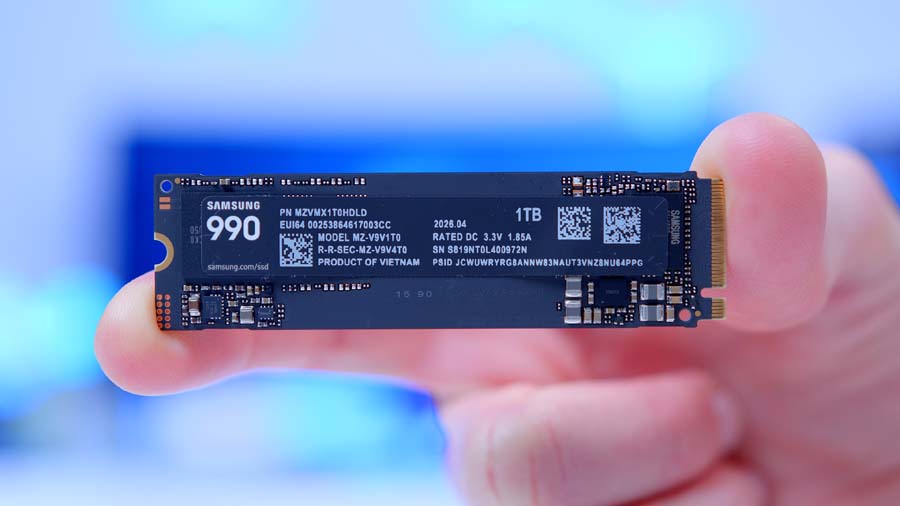
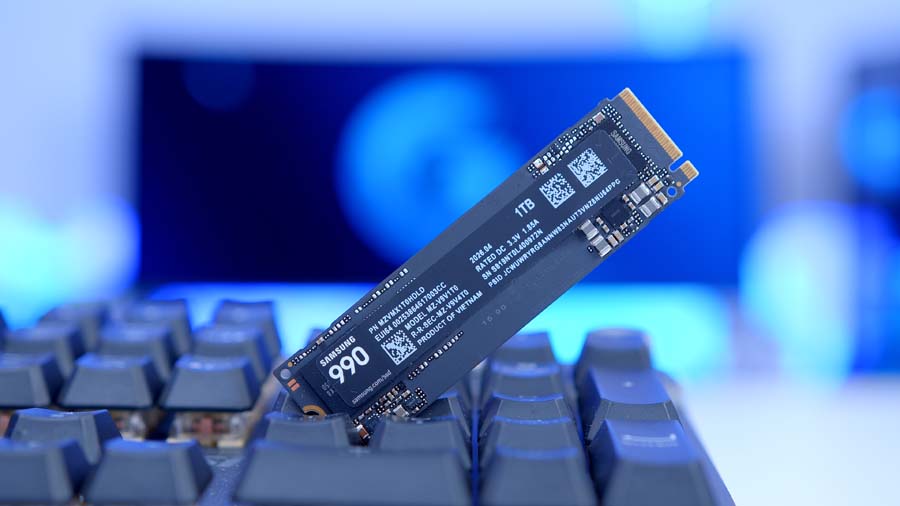
There’s rarely much to say about the way an M.2 drive looks, and the 990 doesn’t set out to change that. It’s a bare, single-sided M.2 2280 stick with a black PCB and a plain Samsung label, measuring 80.15mm long, 22.15mm wide and 2.38mm thick. There’s no bundled heatsink and no RGB, which is exactly what you want if it’s going to live under the M.2 cover on a modern motherboard.
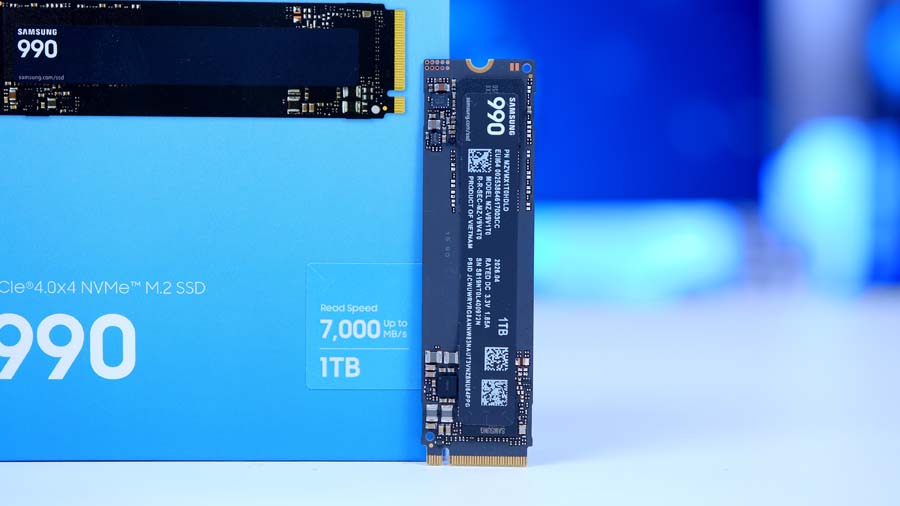
That slim profile matters more than it might first appear. A lot of drives rule themselves out of a PlayStation 5 or a laptop because of a chunky pre-fitted cooler, whereas the 990 keeps its options open. Underneath the label, Samsung has paired its own in-house controller with Samsung V-NAND, and there’s no onboard DRAM cache to speak of. The drive relies on HMB, or Host Memory Buffer, borrowing a slice of your system memory to handle the same job.
The 990 is available in two capacities, and it’s the 1TB model we’ve been testing. For most people that’s a sensible amount of space, though Samsung is quick to point out that plenty of modern AAA games now push past 150GB, so anyone with a larger library will want to weigh up the 2TB version instead.
Current Market Situation
Any conversation about SSD value in 2026 needs a bit of context first. Storage has become dramatically more expensive over the past year, and a 1TB drive now commands the sort of money that would have bought you several times the capacity a couple of years ago. That isn’t Samsung being greedy, it’s the reality of a NAND market that has been reshaped by AI demand, and every manufacturer is in the same boat.
Judged that way, though, the 990 has a problem, and it’s a significant one. Samsung’s own Gen 5 flagship, the 9100 Pro, sits only a modest step above it in price, and it’s a drive that regularly turns up discounted across retailers. That relatively small gap buys you a great deal more too. A Gen 5 interface, a proper onboard DRAM cache instead of borrowed system memory, a five-year warranty rather than three, a considerably higher endurance rating and the flagship controller are all on offer.
That’s the awkward part. Every compromise on the 990, the missing DRAM, the Gen 4 controller, the shorter warranty, exists to bring the price down, and yet the saving you actually pocket is fairly slim. If this drive undercut the Pro by a wide margin, those compromises would be the whole point. As things stand, you’re accepting them for a discount that doesn’t feel proportionate, and that’s a difficult thing to recommend.
There are still two solid cases for buying one. If your motherboard only supports Gen 4, you’d be paying for bandwidth you can’t use with a Gen 5 drive, and the 990 delivers everything that interface has to offer. And if you’re building something compact, whether that’s a laptop upgrade, a mini PC or a cramped small form factor case, the 990’s low power draw and cool running make it a far more sensible companion than a Gen 5 drive that wants a heatsink and plenty of airflow. Outside of those scenarios, our advice would be to stretch if you possibly can.
Features We Like
A Serious Endurance Rating
The figure that stands out on the spec sheet is the TBW rating. The 1TB Samsung 990 is rated for 400TB of writes across its lifetime, with the 2TB model doubling that to 800TB. That’s a strong number for a mainstream Gen 4 drive, and TBW is a reasonable indicator of how much life Samsung expects the NAND to have in it.
The security credentials are worth a mention too. The 990 supports AES 256-bit full disk encryption, so it can be locked down properly if you need it to be. That isn’t always a given on drives aimed at this part of the market.
Power Efficiency and Magician 9.0
Efficiency is where Samsung has focused a good deal of its messaging, claiming the 990’s advanced NAND cuts power consumption by up to 38 percent compared to its previous drives. The rated figures point in the same direction, with the 1TB model drawing an average of 4.0W during reads and 3.7W during writes, and idle draw falling as low as 3mW in its deepest sleep state.
On the software side, the 990 is supported by Samsung Magician 9.0, covering firmware updates, drive health monitoring, data migration and a built-in benchmark tool. It remains one of the more polished storage utilities available.
Features We Don’t Like
A Three Year Warranty
The warranty is the hardest part of this drive to defend. The Samsung 990 is covered for three years, at a time when five has become the expectation for NVMe drives, including a fair few that cost less. Samsung frames the shorter cover as standard for value drives, and the TBW rating is generous enough that most users will never get near exhausting it, but a warranty is about peace of mind as much as anything else. Losing two years of it on a drive that’s designed to be your main system storage is a fair mark against it.
No Onboard DRAM Cache
The 990 is a DRAM-less design, using HMB to borrow system memory rather than carrying a dedicated cache chip of its own. It’s a common enough cost-saving measure, and it plays a part in keeping both the price and the power draw down, but it does mean the drive is leaning on your PC to handle some of its own housekeeping. It also sets a firm ceiling on what this drive can be, and serves as a reminder that the 990 is a mainstream product rather than a successor to the 990 Pro.
Performance
Starting with the headline sequential read figure, the 990 cleared its advertised speed on every single run. We recorded 7,111MB/s, 7,048MB/s and 7,090MB/s across our three passes, for an average of 7,083MB/s. That’s above the 7,000MB/s Samsung quotes on the packaging, and it’s the sort of result we like to see, because plenty of drives quietly land a few hundred megabytes short of their own marketing. It’s also worth noting how tight those three numbers are, with barely 60MB/s separating the best and worst runs, which points to a drive that behaves predictably rather than erratically.
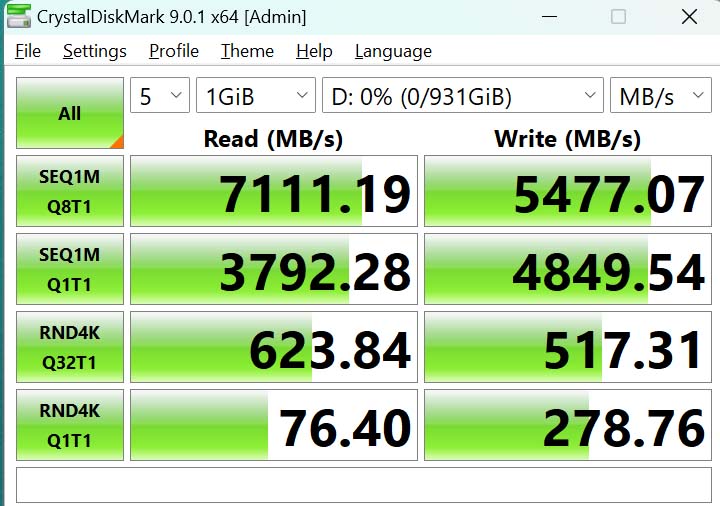
Sequential writes are where the 990 gives some ground back. Samsung rates the drive at up to 6,450MB/s, and across our three runs we recorded 5,477MB/s, 5,621MB/s and 5,628MB/s, for an average of 5,575MB/s. That’s around 86 percent of the advertised figure, and while rated speeds are always a best case scenario measured on the manufacturer’s own bench, a shortfall of roughly 875MB/s is large enough to notice.
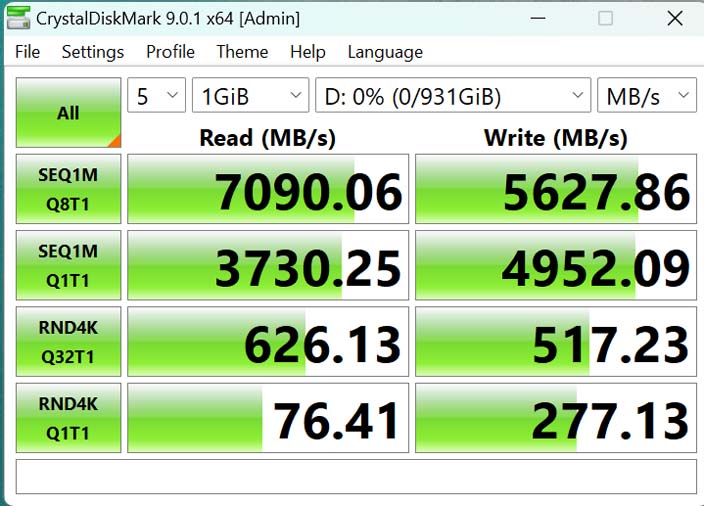
Context matters here, mind you. Even at 5,575MB/s, this drive writes several times quicker than any SATA SSD and comfortably ahead of an entry-level Gen 3 NVMe, so large file transfers, game installs and video exports all move along at a decent clip. Our results were also remarkably consistent, with the three runs falling within roughly 150MB/s of one another.