

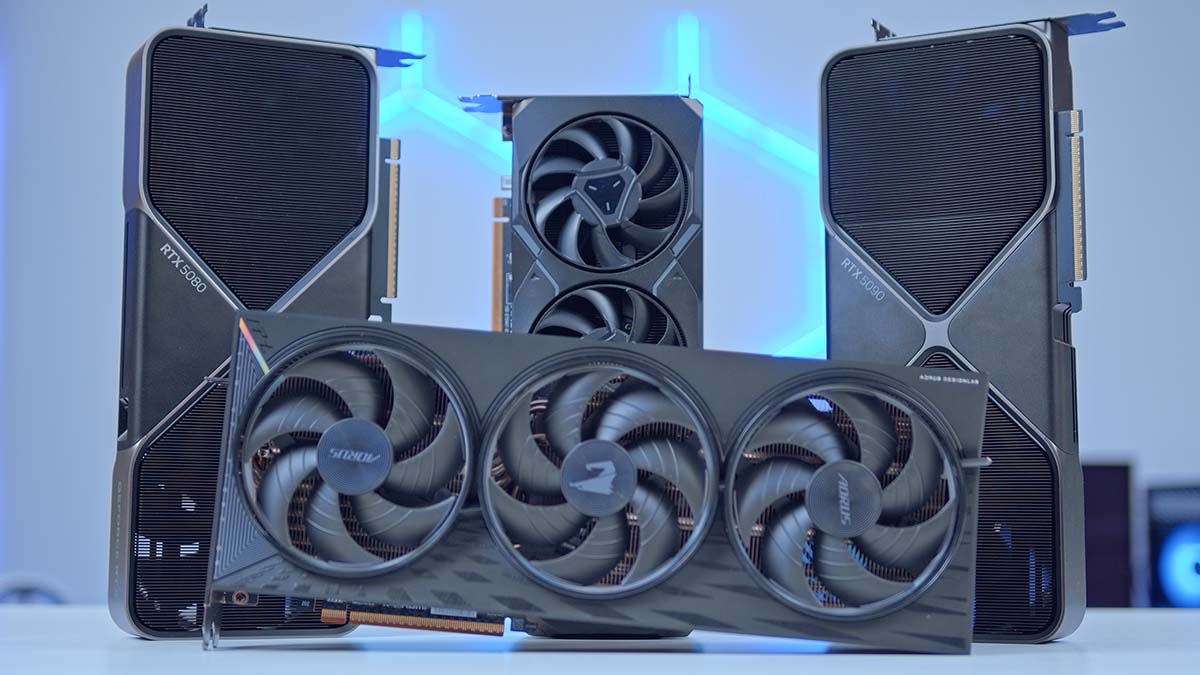
As of late 2025, 4K gaming is the pinnacle of visual fidelity and image quality – something we all aspire to experience with our gaming rigs. If you’re wondering which graphics card will deliver the resolution you’re looking for and how it is forecast to perform over the coming years, we’ve written this article to alleviate the burden and help you find 4K graphics card options tailored to your needs.
At 4K, your graphics card choice is pivotal in determining how well your system performs. Still, with the mundane spec lists from different competitors, it can be challenging to contextualise how either card will benefit your system. So, for each of the GPUs we recommend, we’ll explain their specs and what they mean for your system. To figure out which graphics card is the best option for 4K gaming, we’ve rigorously tested a myriad of options, and we’ll delve into those performance analytics near the end of the article.

Best GPUs for 4K Gaming
1. AMD Radeon RX 9070 XT

Suggested Article: Best CPUs to Buy for the RX 9070 XT
Our first GPU is the AMD Radeon RX 9070 XT, the flagship of AMD’s 9000-series lineup. Built on the RDNA 4 architecture, it represents AMD’s push to deliver high efficiency and competitive performance in the mid- to high-end market. With 64 compute units and 16GB of GDDR6 memory, the 9070 XT is designed to handle modern gaming at 1440p and even 4K with confidence.
This card is positioned as a direct rival to NVIDIA’s RTX 5070 Ti, offering similar performance in rasterised workloads at a more accessible price point. AMD has also made notable strides in ray tracing with this generation, narrowing the gap with NVIDIA’s cards. For gamers weighing options in this tier, the RX 9070 XT offers a compelling balance of performance, efficiency, and value, and it’s worth keeping on your watchlist.
While the RX 9070 XT is marketed as a 1440p powerhouse, its 16GB of VRAM, high clock speeds, and AMD’s FSR/Hypr-RX suite make it surprisingly competent at 4K gaming. It won’t always hit ultra-high frame rates in the most demanding titles, but for gamers looking for smooth 4K performance, this card delivers exceptional value. There is a non-XT version of this graphics card, akin to the way that NVIDIA makes non-TI versions of their graphics cards, but the RX 9070 comes with a lower core clock speed, decreased clock speeds, fewer ray accelerators, and fewer stream processors than the XT version; however, it does cost $50 less.
| Key Specs | AMD Radeon RX 9070 XT |
|---|---|
| Video Memory Capacity | 16GB GDDR6 |
| Memory Bus | 256-bit |
| Core Clock Speed | 2.40GHz |
| Boost Clock Speed | 2.97GHz |
| Stream Processors | 4,096 |
| Ray Accelerators | 64 |
| Power Consumption | 304W |
| MSRP | $599 |
There are areas where this card could be improved. The GDDR6 memory on this card is slower than the GDDR7 you’ll find on this card’s NVIDIA competitor, and AMD’s FSR technology still lags a little behind NVIDIA’s DLSS. However, let’s be realistic and appreciate that such a powerful graphics card is priced reasonably for the smooth frame rates and gameplay it will deliver.


2. NVIDIA GeForce RTX 5080
Suggested Article: Best CPUs to Buy for the RTX 5080
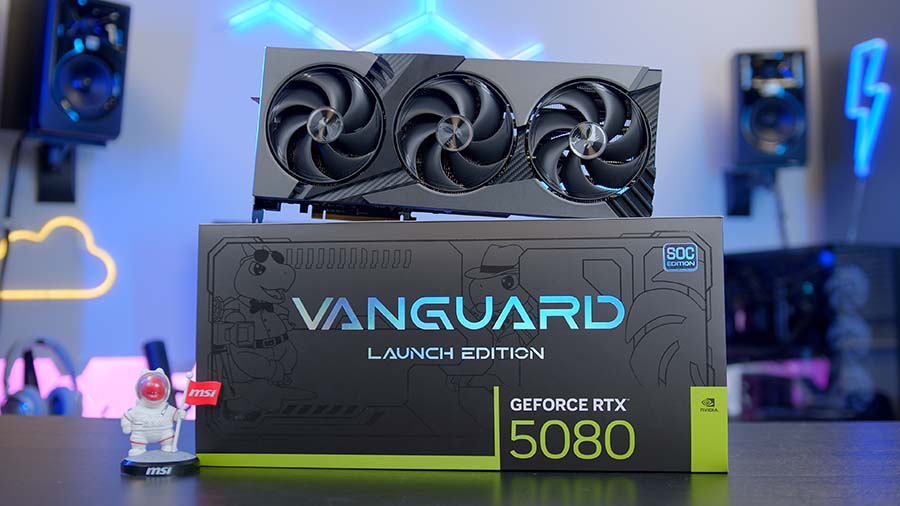
The second graphics card on the roster is NVIDIA’s GeForce RTX 5080, a real powerhouse for 4K gaming. What really sells this card is that its price-to-performance is almost unmatched in comparison to the NVIDIA GeForce RTX 5090. With a 2.30GHz base clock and a 2.62GHz boost, NVIDIA’s RTX 5080 tackles demanding graphical workloads with impressive speed. Backed by a 256‑bit memory interface and 16GB of GDDR7 VRAM, it delivers a potent mix of bandwidth and raw processing power. Keep in mind that clock speeds can vary slightly between models from board partners such as MSI, ASUS, and Gigabyte, as they often come factory overclocked.
The only other graphics card that tends to beat the RTX 5080 in performance metrics is the NVIDIA GeForce RTX 4090, but that card belongs to the previous generation. The RTX 4090 relies on DLSS 3 rather than DLSS 4, and it’s built on the Ada Lovelace architecture, which is expected to age less gracefully than newer designs. Looking ahead, the RTX 5080 is positioned to surpass it, offering a more convincing case as a future‑proof graphics card.
| Key Specs | NVIDIA GeForce RTX 5080 |
|---|---|
| Video Memory | 16GB GDDR7 |
| Memory Bus | 256-bit |
| Base Clock Speed | 2.30GHz |
| Boost Clock Speed | 2.62GHz |
| CUDA Cores | 10,752 |
| RT Cores | 88 |
| Tensor Cores | 336 |
| Power Consumption | 360W |
| MSRP | $999.99 |
if you’re looking to save a little money now and still enjoy excellent performance, the RTX 5070 Ti makes a compelling alternative to the RTX 5080. While it sacrifices a touch of future‑proofing at native 4K, it retains the same Blackwell generation and benefits from DLSS 4, just like the RTX 5080. Thanks to lower base and boost clock speeds and a fundamentally different GPU die, the 5070 Ti remains the slower card overall. That said, you still get access to NVIDIA’s latest frame generation and AI‑driven upscaling, which can dramatically improve smoothness and playability in demanding titles. For gamers who don’t need absolute top‑end performance today but want a card that will age gracefully, the RTX 5070 Ti strikes a strong balance between cost and capability.


3. NVIDIA GeForce RTX 5090
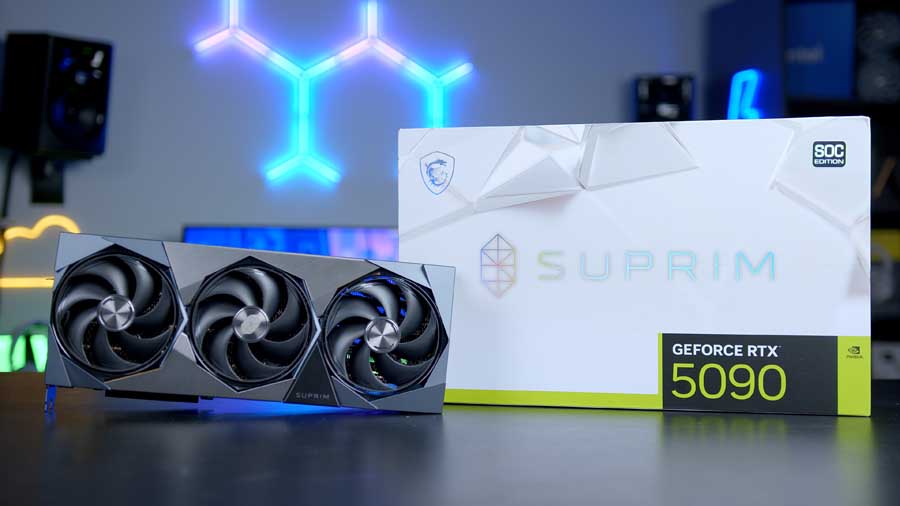
Lastly, we come to the NVIDIA GeForce RTX 5090, and sadly, with this graphics card, the battle comes down to your bank account versus the cost. Unlike the RTX 5080, the 5090 is built on a larger, more powerful GPU die, delivering far more cores and bandwidth. The architecture is what differentiates the two cards. This card exists to push performance ceilings, while the 5080 offers a more affordable, balanced high-end option.
But that’s not where this card earns its stripes. The RTX 5090 flexes with a staggering 32GB of GDDR7 VRAM and a 512-bit memory bus, making it an absolute monster for high-resolution gaming and creative workloads alike. Then we factor in 21,760 CUDA cores for AI-accelerated calculations and 170 RT cores for ray tracing. This card is insane. It will last you a long time, even compared to the other recommendations.
| Key Specs | NVIDIA GeForce RTX 5090 |
|---|---|
| Video Memory | 32GB GDDR7 |
| Memory Bus | 512-bit |
| Base Clock Speed | 2.29GHz |
| Boost Clock Speed | 2.55GHz |
| CUDA Cores | 21,760 |
| RT Cores | 170 |
| Tensor Cores | 680 |
| Power Consumption | 575W |
| MSRP | $1999.99 |
The RTX 5090 delivers more performance than its predecessor, the RTX 4090, in our rasterised test suite and synthetic benchmarks. Had the RTX 5090 been a repackaged RTX 4090 with only the extra AI compute needed for DLSS 4 support, we would have just recommended the RTX 4090, especially considering it would cost you less. But it is not, and it never was going to be a repackaged RTX 4090, because NVIDIA always engineers a new architecture for the successive series.
Where this card truly earns its place is in 4K gaming. It’s not just capable of doing the job. And it does it comfortably. Triple A titles run smoother, sharper, and with more headroom for future updates and visual enhancements. Even with full ray tracing enabled, the RTX 5090 maintains playable framerates that were previously reserved for DLSS-enhanced modes. And with DLSS 4’s multi-frame generation, frame pacing and responsiveness are elevated to a level that feels almost surreal.
If you’re building a system with uncompromised 4K gaming and multimedia content creation to cover you for the next five years, you won’t find a better graphics card. It’s just not a sensible purchase when you factor in real-time pricing; it’s a statement piece.
Suggested Article: Best CPUs to Buy for the RTX 5090


4K Gaming Benchmarks
Alan Wake 2 (4K High, Rasterisation Only)
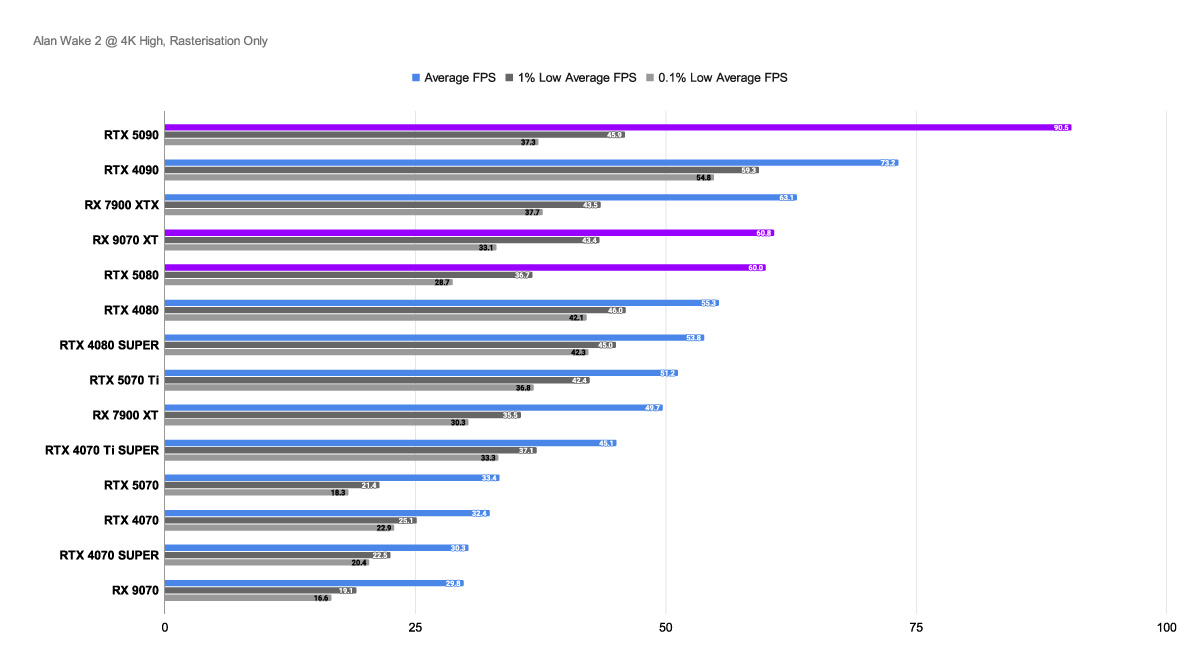
Alan Wake 2 is widely praised for its graphics. It is visually captivating across all platforms, but you need the right kit to fully harness its visual fidelity, especially at 4K. 4K demands serious GPU muscle to maintain fluidity across its dense lighting, particle effects, and cinematic environments. The RTX 5090 leads the group with an average of 90.5 FPS, but what’s more impressive is its 1.0% low of 45.9 FPS and 0.1% low of 37.3 FPS. This indicates not just raw speed but exceptional frame consistency, resulting in fewer stutters and smoother gameplay even during intense sequences. The RTX 4090 trails, averaging 73.2 FPS. However, its 1.0% and 0.1% lows, at 59.3 and 54.8, respectively, are actually higher than the RTX 5090’s. This suggests tighter frame pacing and less variance, although the overall framerate is lower.
AMD’s RX 9070 XT delivers applaudable averages of 60.8 FPS, but its lows dip into the low 30s. This could translate to noticeable hitching during heavy combat or traversal. The RTX 5080, while technically capable, struggles to maintain smoothness at 4K. Its 1.0% low sits at 36.7 FPS, and its 0.1% low at 28.7 FPS, making it the least consistent performer in this lineup. In short, the RTX 5090 offers the highest ceiling in terms of raw performance. The RTX 4090, on the other hand, arguably delivers the most stable experience. Both outperform AMD’s offerings in terms of frame reliability under load.
Cyberpunk 2077 (4K High, Rasterisation Only)
Cyberpunk 2077 at 4K is one of the most demanding titles on the market, and these results highlight just how wide the gap is between NVIDIA’s flagship cards and the rest of the field. The RTX 5090 dominates with an average of 139 FPS, paired with 84.1 FPS at the 1.0% low and 90.4 FPS at the 0.1% low. That combination is unusual, since the 0.1% low is higher than the 1.0% low, but it points to remarkable frame stability and recovery during the most taxing moments. The RTX 4090 follows with an average of 101.7 FPS, 71.5 FPS at 1.0% low, and 70.5 FPS at 0.1% low, showing a more traditional curve and consistent pacing, though it cannot match the sheer headroom of the 5090.
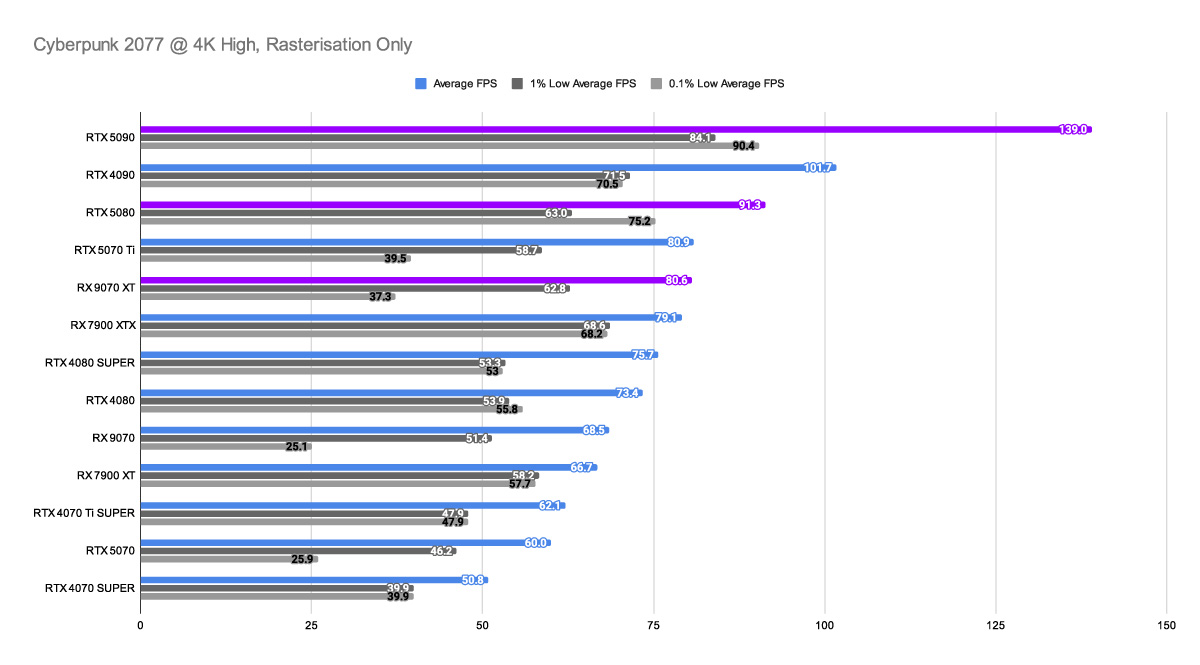
The RTX 5080 delivers 91.3 FPS on average, with 63 FPS at 1.0% low and 75.2 FPS at 0.1% low, which again suggests some variance but still a smoother experience than AMD’s offerings. The RX 9070 XT averages 80.6 FPS, but its 37.3 FPS at 0.1% low is a clear weakness, likely translating into noticeable stutter during heavy ray-traced scenes.
In short, the RTX 5090 not only sets the highest performance ceiling but also demonstrates exceptional frame consistency, making it the most future-proof option for Cyberpunk 2077 at 4K. Even the RTX 4090 remains a strong contender for stability, compared to AMD’s GPUs, which deliver playable averages but struggle to maintain smoothness under more demanding conditions.
Hogwarts Legacy (4K High, Rasterisation Only)
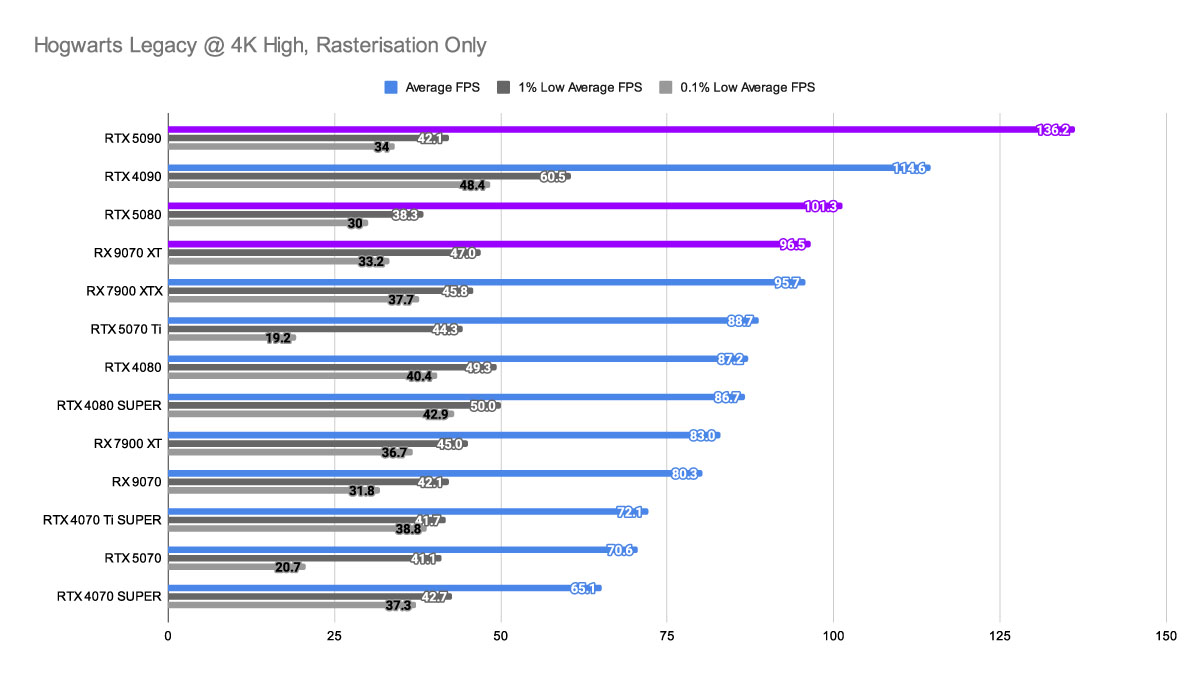
Finally, we present our results from 4K gaming in Hogwarts Legacy, a title that pushes GPUs hard with its expansive environments and heavy reliance on detailed textures and lighting. The RTX 5090 comes out on top with an average of 136.2 FPS, but its 1.0% low of 42.1 FPS and 0.1% low of 34 FPS reveal that while peak performance is unmatched, frame pacing can dip under pressure. The RTX 4090 delivers a lower average at 114.6 FPS, yet its 60.5 FPS at 1.0% low and 48.4 FPS at 0.1% low show a steadier experience overall, with fewer drops during demanding sequences.
The RTX 5080 achieves 101.3 FPS on average, but its lows of 38.3 FPS and 30 FPS highlight the inconsistency that may be felt during traversal or combat. AMD’s RX 9070 XT posts 96.5 FPS average, with lows of 47.0 FPS and 33.2 FPS. AMD card delivers playable framerates but lacks the stability seen in NVIDIA’s higher-end offerings. In summary, the RTX 5090 sets the highest ceiling for raw performance, while the RTX 4090 balances strong averages with more consistent lows, making it the smoother option for 4K Hogwarts Legacy gameplay.

![FI_[DM93] Corsair 3200D Launch](https://geekawhat.com/wp-content/uploads/2026/03/FI_DM93-Corsair-3200D-LAUNCH-551x431.jpg)
![FI_[DM89] Phanteks Evolv + AORUS 5090 9850X3D Gallery (8)](https://geekawhat.com/wp-content/uploads/2026/02/FI_DM89-Phanteks-Evolv-AORUS-5090-9850X3D-Gallery-8-551x431.jpg)
![FI_[DM88] 16GB DDR5 9060 XT Build Gallery](https://geekawhat.com/wp-content/uploads/2026/02/FI_DM88-16GB-DDR5-9060-XT-Build-Gallery-551x431.jpg)
![FI_[DP059] Corsair Frame 4000 + 9070XT](https://geekawhat.com/wp-content/uploads/2026/01/FI_DP059-Corsair-Frame-4000-9070XT-551x431.jpg)
![FI_[SR190] HYTE X50 Ryzen 5 9600X & MSI RTX 5070 Ti](https://geekawhat.com/wp-content/uploads/2026/01/FI_SR190-HYTE-X50-Ryzen-5-9600X-MSI-RTX-5070-Ti-551x431.jpg)