

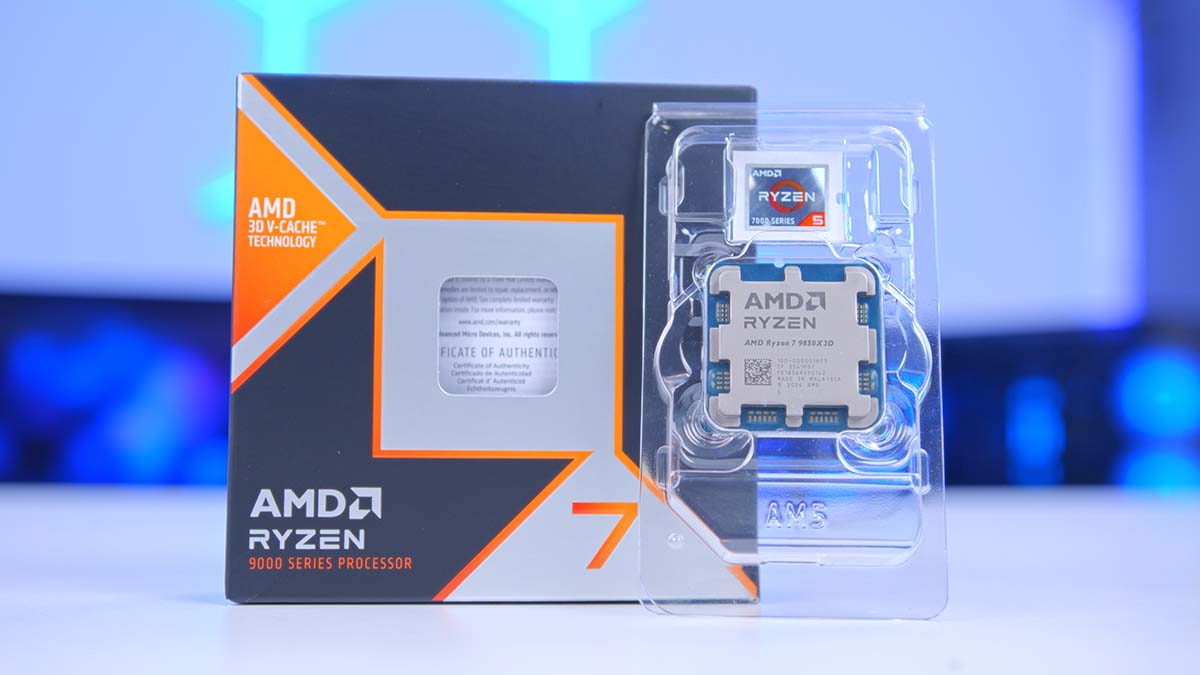
-
Cores
8
-
Threads
16
-
Boost Clock
5.6GHz
-
L3 Cache
96MB
The Ryzen 7 9850X3D is a mid-generation refresh of AMD’s ever-popular Ryzen 7 9800X3D, offering a higher boost clock speed than that of its predecessor. Largely expected to become the new go to option for Gaming CPUs, the additional clock speed bump should, in theory, seat the 9850X3D atop the proverbial pile. Chuck in some manual overclocking support for those who want to eke out every ounce of extra performance, thanks to improvements to AMDs 3D V-Cache tech, and the 9850X3D has potential to put clear daylight between itself and the rest of the competition, for a small price premium, of course.
Ryzen 9000X3D Lineup
CPU Comparison
AMD Ryzen X3D Desktop CPU Comparison
Hover rows for highlight. Drag :: to reorder columns, or tap/click a header title to sort.
| CPU | ::Cores | ::Threads | ::Base Clock | ::Max Boost | ::TDP | ::Total Cache | ::Where to Buy |
|---|---|---|---|---|---|---|---|
 AMD Ryzen 9 9950X3D Zen 5 flagship X3D desktop CPU | 16 | 32 | 4.3 GHz | 5.7 GHz | 170W | 144MB | |
AMD Ryzen 9 9900X3D 12-core Zen 5 X3D for mixed gaming and production | 12 | 24 | 4.4 GHz | 5.5 GHz | 120W | 140MB | |
 AMD Ryzen 7 9850X3D 8-core Zen 5 X3D gaming CPU (launched Jan 29, 2026) | 8 | 16 | 4.7 GHz | 5.6 GHz | 120W | 104MB | |
AMD Ryzen 7 9800X3D High-FPS Zen 5 gaming CPU | 8 | 16 | 4.7 GHz | 5.2 GHz | 120W | 104MB | |
 AMD Ryzen 7 7800X3D Mainstream Zen 4 gaming favorite | 8 | 16 | 4.2 GHz | 5.0 GHz | 120W | 104MB |
Specifications
The specs difference between the 9850X3D and the CPU it refreshes, the 9800X3D, are minimal. Core and Thread count remain the same, L3 cache totals remain the same and other than a fairly healthy bump to boost clock speed, remain largely untouched across the board.
CPU Specifications
Architecture
Zen 5 + 3D V-Cache
Socket
AM5
Cores / Threads
8 / 16
Base / Boost Clock
4.7 GHz / Up to 5.6 GHz
L2 + L3 Cache
8MB + 96MB
TDP
120W
Memory Support
DDR5 (official up to 5600 MT/s)
PCIe Support
PCIe 5.0
Of course, the 9850X3D does make use of the changes to 3D V-cache architectural changes that debuted with the release of the 9800X3D. The 9850X3D is fully overclockable. While the 9850X3D does act in ways as a sort of ‘factory overclocked version’ of what was already the fastest gaming CPU on the market in the Ryzen 7 9800X3D, for those who want to take it that bit further, the option is there. How stable the overclock will be as clock speeds begin to push 6GHz, however, remains to be seen.
Architecture
Developed on the existing Zen5 architecture and debuted for the release of the Ryzen 7 9800X3D, the 2nd generation V-Cache is largely responsible for the further improvements to the X3D chip performance.
The principal change from the 1st generation V-Cache to the 2nd is the location of the V-Cache itself. Originally placed on top of the processor cores, temperatures of the cache were simply too high to allow for stable overclocking support. Where the 2nd generation manages to combat this is by placing the cache underneath. This better aligns the CPU Core complex with the cooling solution, resulting in better temperatures and allowing for better core clock stability under load.
Thermals
Power, Thermals, and Efficiency
Peak CPU Power (Gaming)
136W
Average Gaming Power
113W
Peak Temperature
75°C
FPS per Watt
1.88
Performance
With the hardware side covered, it's time to see what this system actually delivers in-game. For testing, we've focused on a mix of competitive shooters and visually demanding AAA titles to give a realistic spread of workloads. That means fast-paced, high-refresh experiences like Apex Legends and Fortnite, alongside heavier cinematic titles including Battlefield 6, Arc Raiders and Call of Duty: Black Ops 7. The idea is to look at both ends of the spectrum - raw FPS potential and GPU-heavy visual stress.
So performance. Well, the TLDR is that the 9850X3D is, as expected, faster than the 9800X3D, but not by much. Ranging on average from 3-5% faster the 9850X3D does offer stronger performance but in far less dominating fashion than expected.
Take Call of Duty Black Ops 7 for example. We found the 9800X3D to be the faster of the two CPUs across all three resolutions, averaging 4% more performance than the 9850X3D on the whole. Battlefield 6 offers 1.7% more performance on the whole when looking across the 3 resolutions and only due to its healthy 8% lead at 1080p. We actually found the 9800X3D to be faster in Battlefield 6 at both 1440p and 4K High settings. Arc Raiders provides some more promising reading with +6.1% at 1080p and +4.5% at 1440p but does again falter in the final resolution. This time with -4.2% at 4K. Fortnite and Marvel Rivals do offer much healthier results for the 9850X3D and we typically see it winning across the board here apart from a -0.6% average in Fortnite at 1440p.
However, and it is quite a big however. By pushing the boost clock that much higher in an attempt to squeeze out the extra performance and I mean really squeeze it out at times. AMD have seemingly just allowed for a heap of extra wattage to be pumped through the CPU. On average we found the 9850X3D to pull in excess of 40% more power, with temperatures on the 9850X3D chip also increasing by up roughly 15-20%.
From Our Full Test Suite
CPU Comparison Testing

Conclusion

Related Posts

![FI_[SR190] HYTE X50 Ryzen 5 9600X & MSI RTX 5070 Ti](https://geekawhat.com/wp-content/uploads/2026/01/FI_SR190-HYTE-X50-Ryzen-5-9600X-MSI-RTX-5070-Ti-551x431.jpg)
![FI_[DP064] ASUS Prime AP303 + 9070XT](https://geekawhat.com/wp-content/uploads/2026/03/FI_DP064-ASUS-Prime-AP303-9070XT-551x431.jpg)