

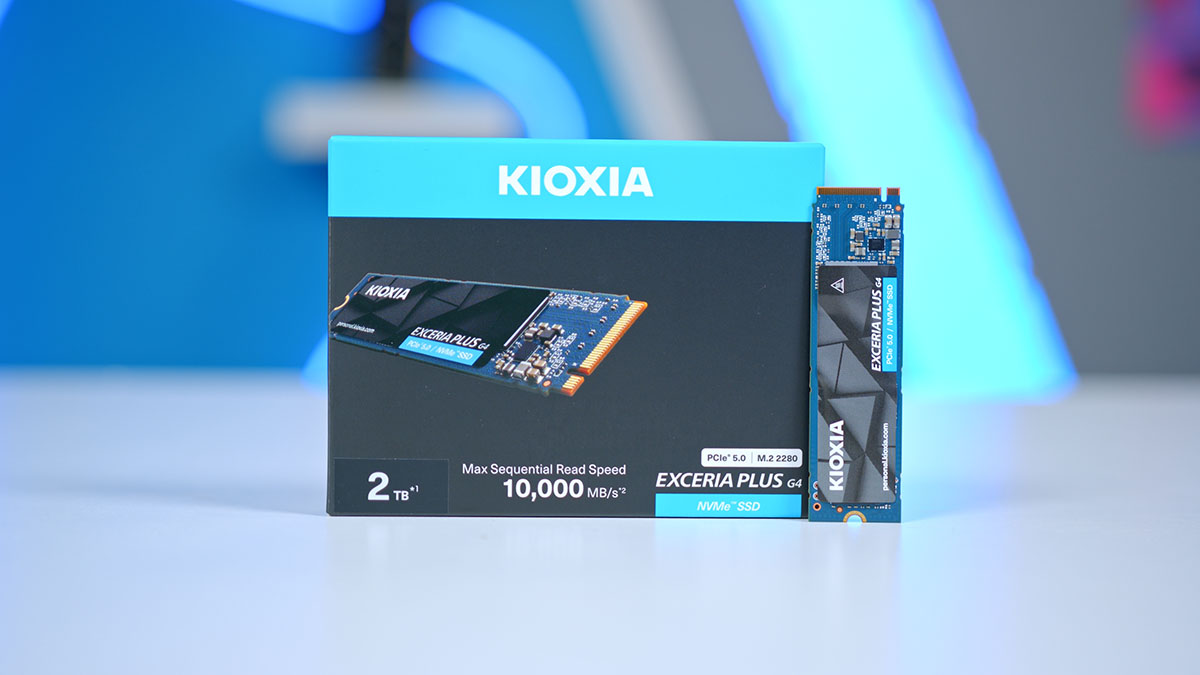
KIOXIA might still feel like a newcomer in the consumer storage market, but it carries a heavy legacy as the former Toshiba Memory, which changed its name in October 2019. While their portable SSDs are starting to pop up on more shelves, the brand remains a bit of an underdog compared to the industry titans. However, given the ongoing volatility and drama surrounding storage-related component pricing, exploring alternative brands is no longer just an option – it’s a necessity for finding the best value. Enter the KIOXIA EXCERIA PLUS G4, released in 2025, a newer storage component that is set to be a contender for mid-range PC systems, for the use of gaming and general activities.
In this review, we’re putting the KIOXIA EXCERIA PLUS G4 with a capacity of 2TB to the test. We’ll dive into our benchmark statistics, share our hands-on experience, and determine if this drive is the reliable, high-performance solution the market needs right now.
Buy the KIOXIA EXCERIA PLUS G4 on:
1TB Capacity
2TB Capacity
Specification
KIOXIA’s EXCERIA PLUS G4 is a standard M.2 2280, measuring 22 mm high by 80 mm long, making it compatible with a broad range of modern motherboards. Unfortunately, the EXCERIA PLUS G4 is only available in two capacities, 1TB and 2TB; these are the most popular sizes, at least, but they don’t leave much room for flexibility. Omitting the development of larger capacities, such as 4TB and 8TB, alienates enthusiasts, thereby narrowing KIOXIA’s product reach.
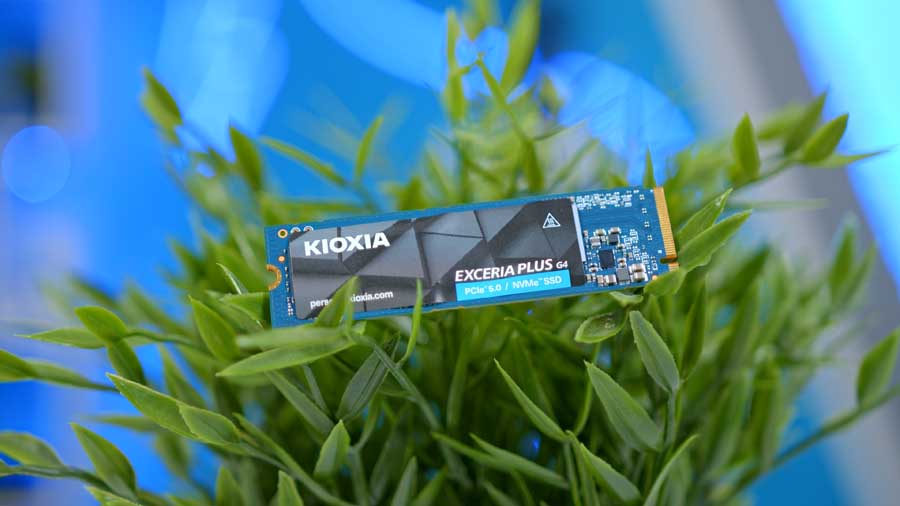
KIOXIA advertise that this drive can reach sequential read speeds of up to 10,000 MB/s for both storage sizes, but the write speeds do offer a slight disparity, where the sequential write speeds for the 1TB capacity can reach up to 7,900 MB/s, and the write speeds for the 2TB version can reach up to 8,200 MB/s. Typically, the higher the capacity, the faster the data transfer speeds.
| Specification | KIOXIA EXCERIA PLUS G4 |
| PCI-E Generation | PCIe Gen5 x4 (NVMe 2.0) |
| Capacity | 1TB, 2TB |
| Sequential Read Speed | Up to 10,000 MB/s |
| Sequential Write Speed | 1TB: 7,900 MB/s 2TB: 8,200 MB/s |
| Warranty | 5 Years |
| Endurance (TBW) | 1TB: 600 TBW 2TB: 1,200 TBW |
| Form Factor | M.2 2280 (Single-sided) |
The drive’s endurance is nothing unusual and follows the standard for most 1TB and 2TB drives, with a 600 TBW (Terabytes Written) rating and a 1200 TBW rating, respectively. And finally, KIOXIA upholds the normal five-year warranty length that most other brands provide. Looking at the specs table, we can say this Gen5 x4 NVMe drive is nothing particularly special, but it should perform at a standard worth paying for.
KIOXIA EXCERIA PLUS G4 Design
The EXCERIA PLUS G4 immediately stands out with its striking blue PCB, a refreshing departure from the usual black or green boards seen in many consumer NVMe drives. Sitting on top is an eye‑catching heat spreader that echoes KIOXIA’s signature design language, featuring geometric, three‑dimensional patterns that give the drive a modern, engineered aesthetic.
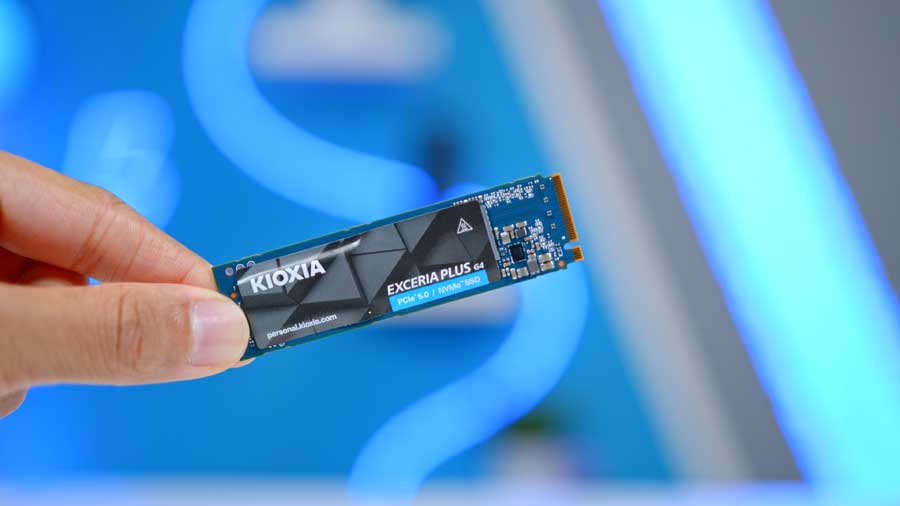
KIOXIA has opted for a single‑sided layout. It’s an evolutionary approach to storage that stacks memory cells vertically in layers to achieve higher density, better performance, and lower cost than traditional 2D flash, used in SSDs and smartphones. It’s called BiCS FLASH (Bit Cost Scalable Flash), and it is KIOXIA’s very own 3D NAND flash memory technology. All memory components sit on one side of the PCB, which not only contributes to a cleaner, more streamlined appearance but also enables a slimmer overall profile, making it ideal for compact builds, laptops, and thermally constrained environments.
There is a significant trade-off here with this implementation, though; this drive does not use DRAM. DRAM is a superfast cache that acts as a buffer between the host and the NAND, or the BiCS Flash in this case. Without DRAM, the SSD must rely on a smaller, slower alternative such as Host Memory Buffer (HMB) or internal SRAM. It’s typically a move to decrease the production cost of such hardware. We can compare the EXCERIA PLUS G4 to the Exceria Pro G2, which uses DRAM and offers high speeds across the board, but will likely cost much more than the PLUS 4.
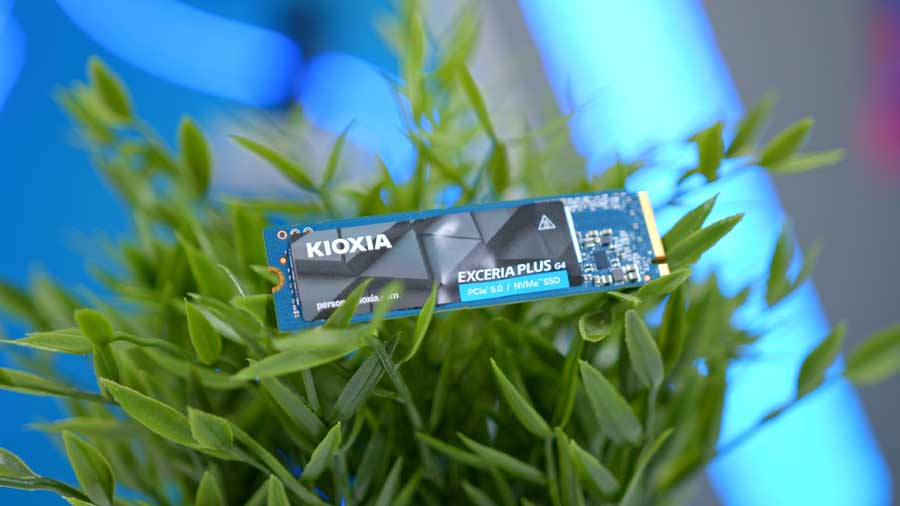
Given the physical composition of this M.2, from the heat spreader label to the single‑sided layout, it would be unusual to require a heatsink to use this drive. This could explain why KIOXIA have chosen to give this drive more visual flair than most other drives on the market.
Thermals against Performance
Thermals
To gauge the KIOXIA EXCERIA PLUS G4’s temperatures, we ran CrystalDiskMark and HWMonitor to record temperatures. CrystalDiskMark is a storage benchmarking application that applies an artificial load to a drive of your choice. Once the benchmarking run has finished, it will return read and write speeds. HWMonitor provides real-time data on utilisation, power consumption, and, most importantly, temperatures, allowing us to determine how the drive performs under a sustained workload. When we install the SSD, we do not use a heatsink because it introduces a control variable that could skew yield across all M.2 drives.

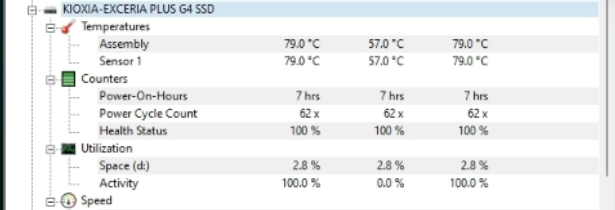
During testing, we found that the KIOXIA EXCERIA PLUS G4 maintained an average of 70℃ while at full load, most M.2 drives can only withstand temperatures around 70℃ before they start throttling; in fact, we even saw a maximum temperature of 79℃, which means that we would recommend using a heatsink with this drive it you plan on using it for demanding tasks. You risk sustained thermal throttling and reduced performance if you don’t take extra measures to keep this drive cool.
Performance
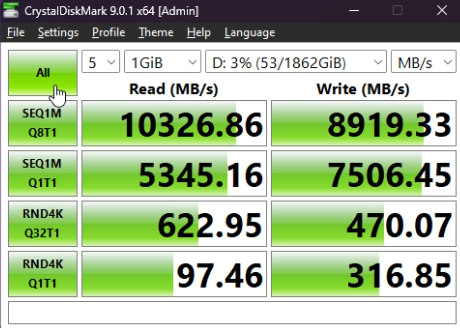
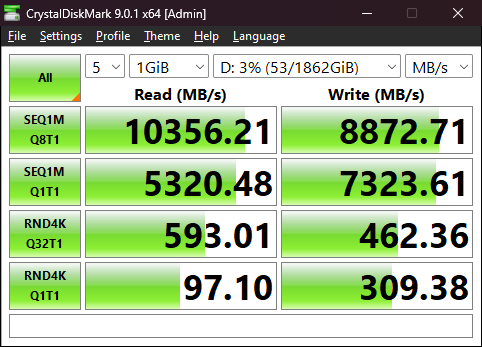
This next section breaks down our results for many Gen5 SSDs we have tested (including this one) and compares them with other Gen5 SSDs we have tested. Highlighted in purple is the KIOXIA EXCERIA PLUS G4, and what we’re hoping for are results that align with what the companies advertise. We ran two tests, EXCERIA PLUS G4, and both times the Drive sat at around 10,300MB/s, yielding a slightly higher result than expected for sequential reading speeds. Whilst we have to allow some room for values to change in real-world testing, KIOXIA advertised maximum speeds of 10,000 MB/s, so this is truly a pleasant surprise! The next important value is the sequential write speed, which we recorded at 8,900 MB/s. Compared to the advertised maximum writing speed of 8,200 MB/s for the 2TB capacity, we are blown away.
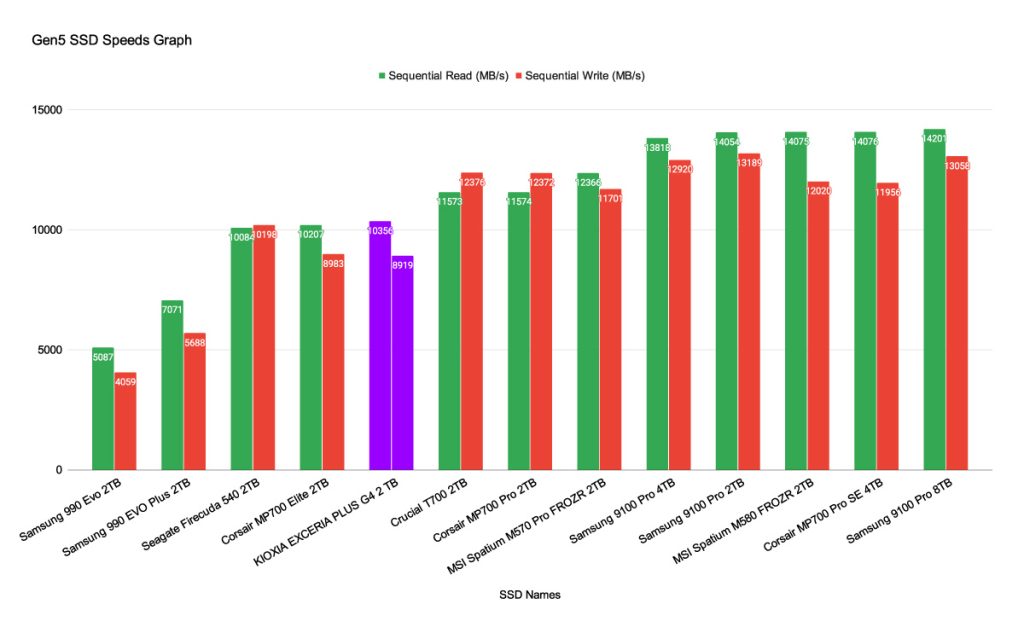
Looking at the graph above, we can see that the EXCERIA PLUS G4 is not the fastest Gen5 NVMe; it falls slightly behind the Crucial T700 which is fine as this drive advertises sequential reading and writing speeds of 12,400MB/s and 11,800MB/s respectively, still, the T700 has since fallen to a similar price point as of January 2026 so if you’re looking for a performance gain it may be worth directing your interest towards, plus it comes with a heat sink. The EXCERIA PLUS G4 does perform slightly better than the Corsair MP700 Elite, which is advertised to deliver the same performance in sequential reading speeds. The MP700 does beat out the EXCERIA PLUS G4 in sequential writing speeds. Both the T700 and EXCERIA PLUS G4 hold more competitive pricing over the MP700 Elite.
Conclusion
KIOXIA EXCERIA PLUS G4 SSD

Product Name: EXCERIA PLUS G4
Brand: EXCERIA PLUS G4
-
Features
-
Design
-
Performance
-
Value For Money
Summary
Overall, the KIOXIA EXCERIA PLUS G4 is an SSD that offers robust performance, performing above expectations. Often, during testing, we find that storage drives perform slightly below the advertised specifications, but this is certainly not the case for the KIOXIA EXCERIA PLUS G4. We are really happy with the design and aesthetics of the NVMe drive, as well as the engineering behind its architecture. It’s clear that this M.2 was built around a customer-first narrative, with KIOXIA’s BiCS Flash integration, and the goal is to deliver the best performance they can with their own technology rather than outsourcing to other OEMs. KIOXIA is a major OEM itself, so it’s no massive surprise.
Unfortunately, SSD prices have risen over recent months, and as of January 2026, you are most likely paying more than you would for a new M.2 drive, though this drive is still priced incredibly competitively compared to other drives. The KIOXIA EXCERIA PLUS G4 is definitely worth investing in if you have an extra heatsink available.
Pros
✅ Amazing performance
✅ Future-proof for Gen5 systems
✅ Competitive pricing
Cons
❌ Troublesome thermals
❌ DRAM-less design
❌ Little flexibility across capacity sizes

![FI_[DM85] O11D Evo RGB White + 5080](https://geekawhat.com/wp-content/uploads/2025/12/FI_DM85-O11D-Evo-RGB-White-5080-551x431.jpg)