
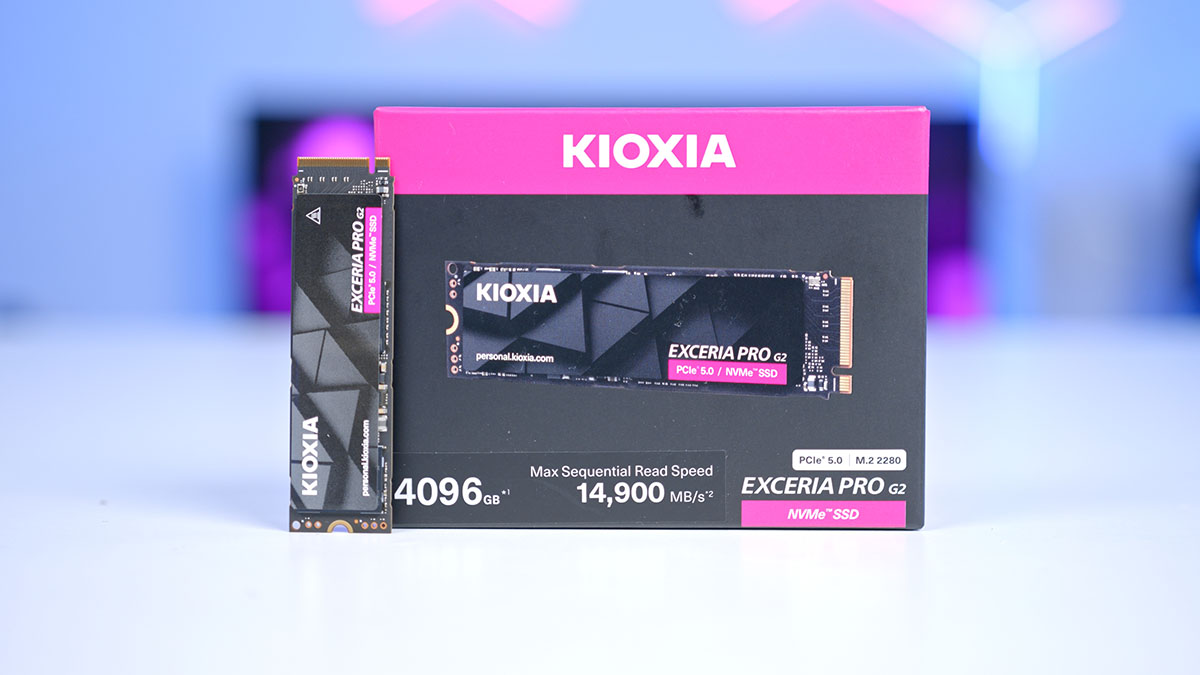
During our review of the KIOXIA EXCERIA PLUS G4 – our very first review of KIOXIA’s products – we found that we were very impressed by the overall handling of the drive and that KIOXIA is a brand to keep an eye on. Now, KIOXIA is back with a new M.2 NVMe SSD positioned as an incredibly fast drive that might even rival the jaw-dropping speeds we saw from the Samsung 9100 Pro.
Again, the market for memory-related devices has come under extreme pressure, especially in the United States, where prices are soaring to levels not seen before. This means that any electrical device that requires storage will start to suffer. For example, video game consoles like the PlayStation 5, mobile phones, and smart home devices all use the same NAND flash, which is heavily monopolised within the AI bubble.
In this review, we’ll test the 4,096GB capacity of the premium KIOXIA EXCERIA PRO G2 against its advertised specifications, see how it copes thermally under load, dive into our benchmark results, share our hands-on experience, and determine whether this drive is at the same enthusiast level it is poised as, or whether it disappoints in our conclusion of the review.
Buy the KIOXIA EXCERIA PRO G2 on:
1,024GB Capacity
2,048GB Capacity
Specification
The KIOXIA EXCERIA PRO G2 is positioned as the company’s new flagship SSD, offered in three capacities – 1,024GB, 2,048GB, and 4,096GB – each with its own performance profile. The 1,024GB model delivers up to 14,400 MB/s sequential read and 12,700 MB/s sequential write speeds, while the 2,048GB and 4,096GB versions push read speeds slightly higher to 14,900 MB/s. Write performance scales with capacity as well, with the 2,048GB model reaching 13,400 MB/s and the 4,096GB model topping out at 13,700 MB/s.
Specification
| Model | KIOXIA EXCERIA PRO G2 |
|---|---|
| PCIe Generation | PCIe Gen5 x4 (NVMe 2.0) |
| Capacity | 1,024GB / 2,048GB / 4,096GB |
| Sequential Read Speed |
1,024GB: 14,400 MB/s
2,048GB, 4,096GB: 14,900 MB/s
|
| Sequential Write Speed |
1,024GB: 12,700 MB/s
2,048GB: 13,400 MB/s
4,096GB: 13,700 MB/s
|
| Warranty | 5 years |
| Endurance |
1,024GB: 600TB
2,048GB: 1,200TB
4,096GB: 2,400TB
|
| Form Factor |
1,024GB, 2,048GB: M.2 2280-S3-M
4,096GB: M.2 2280-S4-M
|
All three drives leverage the latest PCIe Gen5 interface – just like the EXCERIA PLUS G4 – and use the familiar M.2 2280 form factor, ensuring broad compatibility with modern motherboards. The “S3‑M” and “S4‑M” suffixes denote differences in module thickness, something we’ll explore further in the design section.
Each capacity also carries endurance ratings that align with industry expectations for drives of its size.
Each capacity follows the standard endurance you would expect for its storage size, with higher‑capacity models offering proportionally higher TBW ratings to support heavier workloads and a longer service life.
KIOXIA EXCERIA PRO G2 Design
The EXCERIA PRO G2 features a clean black PCB, so if you choose not to use a matching motherboard heatsink, it won’t stick out like a sore thumb. Sitting on top is a heat spreader label that carries KIOXIA’s signature design language, with geometric, three‑dimensional patterning that gives the drive a modern, engineered look. A small hot‑pink accent in the lower‑right corner adds a subtle but distinctive visual detail.
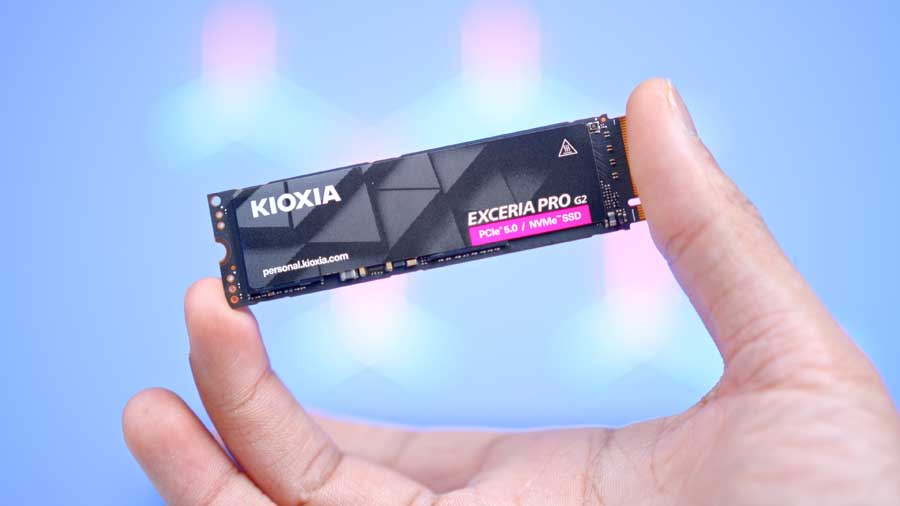
Internally, the drive is built around KIOXIA’s BiCS FLASH technology, a 3D vertical NAND structure that stacks memory cells in layers rather than spreading them across a planar surface. This approach enables higher density, improved write endurance, and better overall performance than traditional 2D NAND. KIOXIA has also engineered the EXCERIA PRO G2 to be a single‑sided M.2 module, consolidating all components on one side of the PCB. However, this generation introduces a notable difference: the 4TB model is physically thicker than the lower-capacity models due to the increased number and height of NAND packages required for the 4TB capacity. As a result, systems with tight M.2 clearance – particularly laptops or compact SFF builds – may need to verify compatibility.
Compared to the EXCERIA PLUS G4, the EXCERIA PRO G2 expands the lineup to a 4TB option, and that additional capacity is made possible by KIOXIA’s latest 218‑layer BiCS8 TLC NAND. This generation uses CBA wafer‑bonding technology to achieve greater bit density, enabling higher capacities without compromising performance or durability. It’s a drive designed to take the heaviest workloads to the next level, for AI generation and CG production applications, as well as high-performance gaming, which is why it sits solidly in the enthusiast-grade spec.
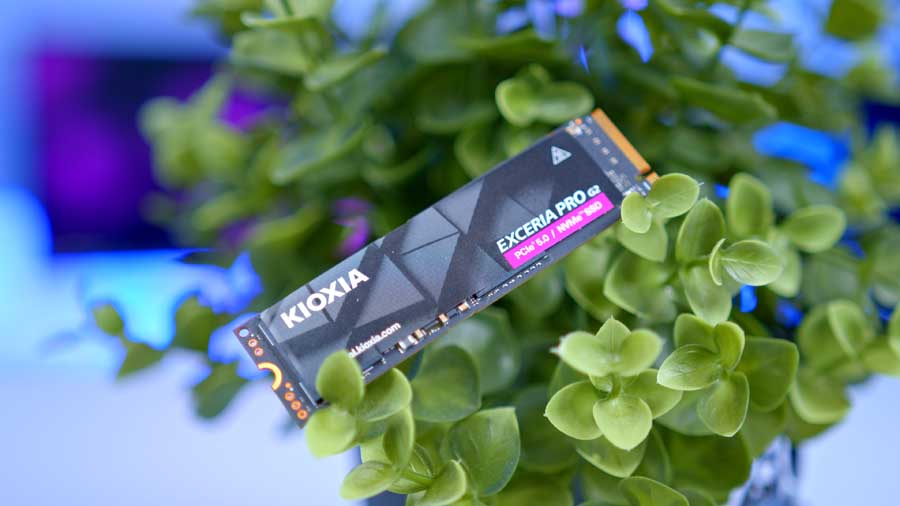
A comment we made about the EXCERIA PLUS G4 was that the thermals were slightly higher when used without a heatsink. We hope to see this change when we test the PRO G2, as it is designed with efficiency in mind. EXCERIA PRO G2 SSDs use less power, reducing the heat generated in your system. Its heatspreader is also designed to enhance heat dissipation, ensuring stable performance during heavy workloads.
A key feature to be aware of with this drive is its DRAM cache integration, which is the main reason it can actually compete with the Samsung 9100 Pro, unlike the DRAM-less G4. DRAM cache is integral for maintaining fast, consistent random read/write speeds, reducing latency, and enhancing drive longevity, especially under heavy workloads. It can access the mapping table more quickly, resulting in better drive endurance and higher sustained, consistent speeds.
Thermals
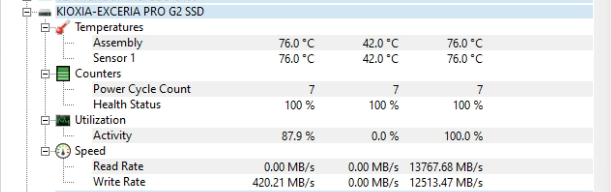
To gauge the KIOXIA EXCERIA PRO G2’s temperatures, we ran CrystalDiskMark and HWMonitor to record temperatures. CrystalDiskMark is a storage benchmarking application that applies an artificial load to a drive of your choice. Once the benchmarking run has finished, it will return read and write speeds. HWMonitor provides real-time data on utilisation, power consumption, and, most importantly, temperatures, allowing us to determine how the drive performs under a sustained workload. When we install the SSD, we do not use a heatsink because it introduces a control variable that could skew yield across all M.2 drives.
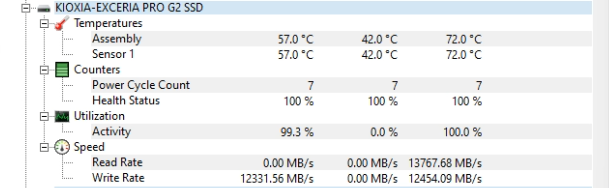
At near 100% drive activity, we saw temperatures of 57℃ – this equates to the lower range of what is typically expected during heavy load, meaning that this drive is actually handling thermals fairly well! Later on, we see the drive sitting at about 76℃, which is certainly on the higher side, but it is worth mentioning that this was during the sequential writing speed test, which is more demanding on an SSD, and it still didn’t come close to the maximum of 85℃, which we almost certainly do not want to reach.
Performance
We ran one test schedule, which in itself runs 5 tests and averages the results. Overall, the EXCERIA PRO G2 sat at about 14,250 MB/s, yielding slightly lower sequential read speeds than advertised. Whilst we have to allow some room for values to change in real-world testing, KIOXIA advertised maximum speeds of 14,900 MB/s for the 4TB capacity; this difference of around 650 MB is virtually negligible in use, though!
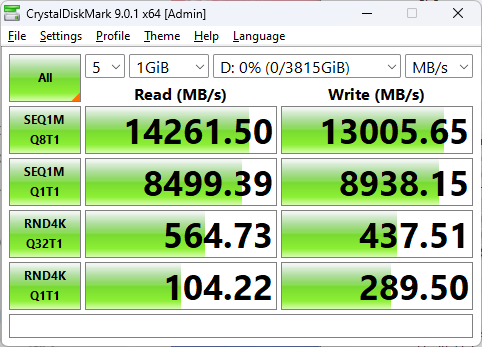
The next important value is the sequential write speed, which we recorded as roughly 13,000 MB/s. Compared to the advertised maximum writing speed of 13,700 MB/s for the 4TB capacity, again, you won’t feel this difference on a larger scale, but it is slightly disappointing that it didn’t quite hit the advertised speed for either side of the test, especially when we quite often see SSDs surpassing expectations – we even saw this with the other KIOXIA drive we tested.
This next section breaks down our results for many Gen5 SSDs we have tested (including this one) and compares them with other Gen5 SSDs we have tested.
From Our Full Test Suite
Gen5 SSD Sequential Performance Testing

Impressively, the KIOXIA EXCERIA PRO G2 4TB is our new reigning champion, outperforming one of our favourite drives, which we deem as one of the Best SSDs to buy in 2026 – the Samsung 9100 Pro in both the 4TB and 8TB capacities for sequential reading. And whilst we can understand that this KIOXIA drive could outperform the 4TB 9100 Pro, we are delightfully shocked to see it perform better than the 8TB drive, as typically with higher storage comes better performance!
In terms of sequential writing speeds, the EXCERIA PRO G2 4TB makes the top three, with the Samsung 9100 Pro 2TB in the lead, thanks to its writing speed of 13189 MB/s. It’s an all-round good performance from the EXCERIA PRO G2, even if it didn’t fully meet expectations.
Conclusion
Overall Score
4.9 / 5
A premium Gen5 SSD with standout speed, broad capacity options, and genuinely innovative high-end positioning.

Awarded the GeekaWhat Innovation Award
KIOXIA EXCERIA PRO G2 Review Verdict
In conclusion, the KIOXIA EXCERIA PRO G2 is a high-end premium M.2 drive. It performs well, looks great, utilises up-to-date features, manages thermals well, even underload without a heatsink, and, if we ignore the current pricing climate and opt for MSRP, this drive is priced incredibly fairly. However, right now in spring 2026, it is expensive like all other SSD options, so it is understandable if you want to wait to pay a fair price for this drive.
Whilst we didn’t see the drive hit the 14,900 MB/s and 13,700 MB/s speeds advertised by KIOXIA, this drive beat out our reigning champion in 4TB capacity versus the 8TB of the champion for sequential reads, and felt slightly behind expectations in sequential writes – it’s worth remembering that this could be due to environmental differences yet again.
Features
5 / 5
Design
5 / 5
Performance
4.5 / 5
Value For Money
5 / 5
Pros
- Uses DRAM cache
- Exceptional speeds overall
- Good capacity range
Cons
- Expensive
- Possible clearance issues
- Didn’t reach expected speeds

![FI_[SR190] HYTE X50 Ryzen 5 9600X & MSI RTX 5070 Ti](https://geekawhat.com/wp-content/uploads/2026/01/FI_SR190-HYTE-X50-Ryzen-5-9600X-MSI-RTX-5070-Ti-551x431.jpg)
![FI_[DP064] ASUS Prime AP303 + 9070XT](https://geekawhat.com/wp-content/uploads/2026/03/FI_DP064-ASUS-Prime-AP303-9070XT-551x431.jpg)