
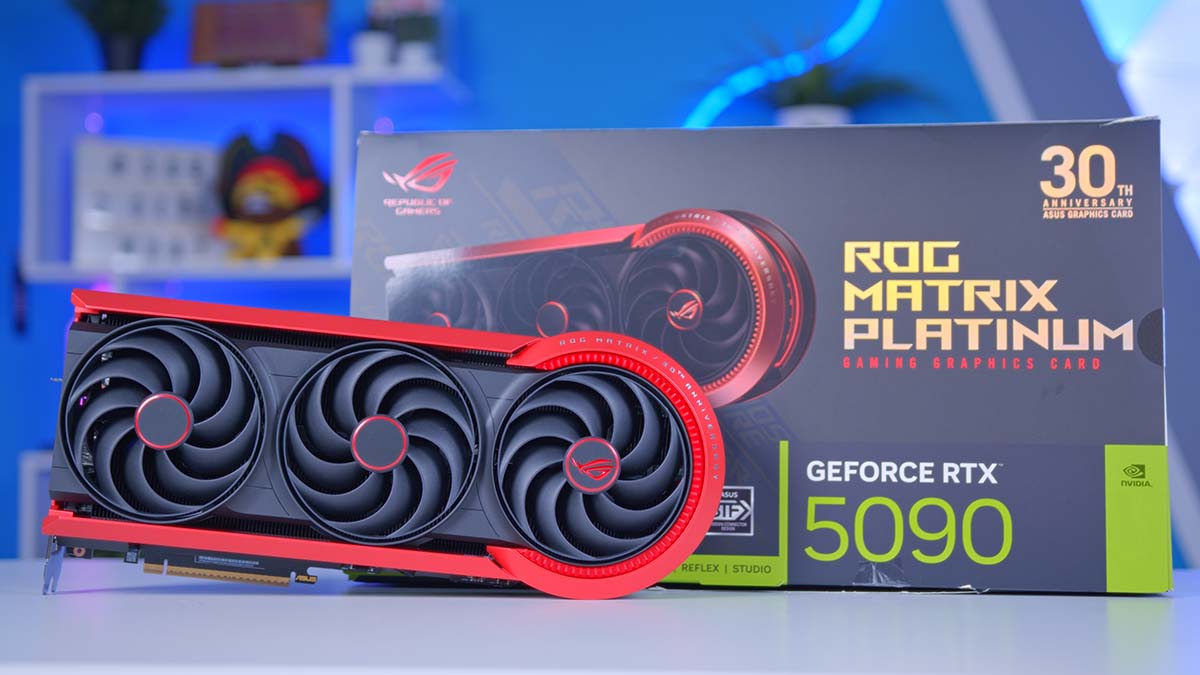
Launched as part of ASUS’s 30th Anniversary celebration, the ROG MATRIX Platinum RTX 5090 is unequivocally the most powerful consumer GPU currently on the market. Built as a no-compromise showstopper, ASUS has pulled out all the stops to seat the MATRIX RTX 5090 atop the proverbial GPU pile in what is perhaps their most ambitious card design yet. But how does it stack up against the competition? Does it truly conquer, or does it falter under the weight of its own excess?
Well, in this review we’ll be covering just that, breaking down the specs, dissecting the outlandish design, exploring the technology under the hood, and of course putting the MATRIX RTX 5090 through its paces to determine them all-important performance numbers.
Specification
As you can imagine, the MATRIX RTX 5090 has one of, if not, the craziest list of specs for a Graphics Card we’ve seen to date. On top of the standard set of 5090 specs the MATRIX 5090 is capable of pushing upwards of 2.75GHz clock speeds and up to 800W and yes you read that right, 800W! – More on this below.
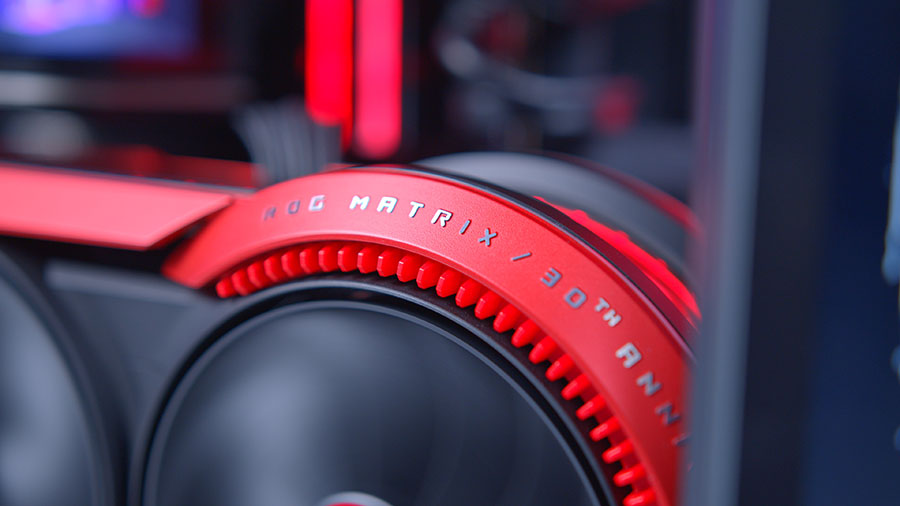
As is increasingly becoming the standard, the MATRIX RTX 5090 features a dual BIOS. One for those who wish to pursue all of the FPS, in the form of a performance mode and for those who prefer a quieter mode of operation whilst still keeping that chart-topping performance, you’ll be happy to hear that the second BIOS is is a Quiet mode. Selecting the preferred BIOS mode is very simple and as easy as flicking a switch on the GPU PCB.
| Key Specs | ASUS ROG MATRIX RTX 5090 | MSI SUPRIM LIQUID RTX 5090 | Founders RTX 5090 | RTX 4090 |
|---|---|---|---|---|
| Video Memory | 32GB GDDR7 | 32GB GDDR7 | 32GB GDDR7 | 24GB GDDR6X |
| Memory Bus | 512-bit | 512-bit | 512-bit | 384-bit |
| Base Clock Speed | 2.01GHz | 2.01GHz | 2.01GHz | 2.23GHz |
| Boost Clock Speed | 2.73GHz (Boost) 2.76GHz (OC) | 2.58GHz | 2.41GHz | 2.52GHz |
| CUDA Cores | 21760 | 21760 | 21760 | 16384 |
| RT Cores | 170 | 170 | 170 | 128 |
| Tensor Cores | 680 | 680 | 680 | 512 |
| Power Consumption | Up to 800W (BTF) | 600W | 575W | 450W |
| MSRP | $3999.99 | $2499.99 | $1999.99 | $1599.99 |
As expected, the dimensions of the MATRIX 5090 are substantial with the card clocking it at just shy of being a 4-slot design. The MATRIX 5090 dimensions are as follows: 370.3 x 150.5 x 77.3 mm. Recommended PSU wattages also take a bump upwards, with ASUS suggesting a 1200W+, accounting for the increase to power consumption in dual-power input operation.
Design
Now, arguably the standout aspect of the MATRIX RTX 5090, the design.
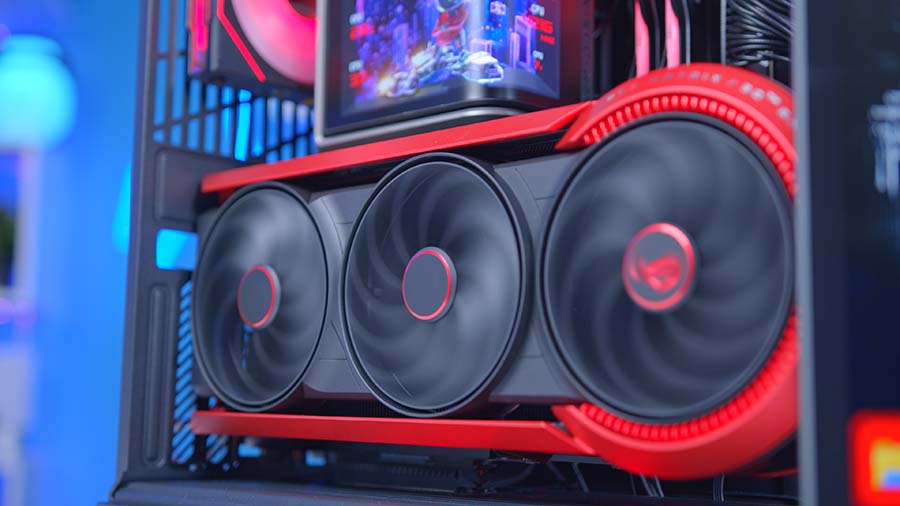
The MATRIX RTX 5090 is striking if nothing else, that much is certain, but beneath the bold and ambitious design choices lie some impressive pieces of engineering. Of course on initial glance, the most obvious design choice on show is the signature ROG red and black colour scheme, something I initially had reservations about, but after seeing it in person can fully get behind. It’s sleek and doesn’t oversaturate the design, accenting rather than drowning.
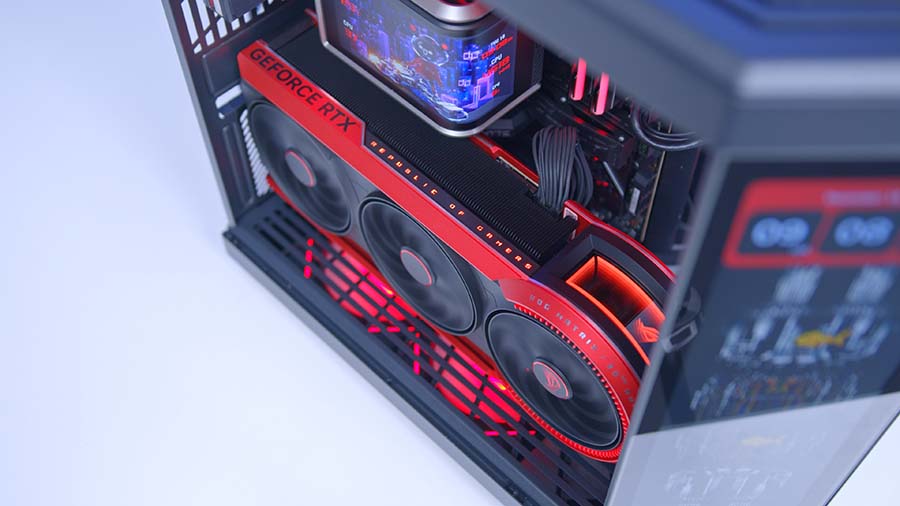
The chassis silhouette again treads close to the limit with the bulbous rear section but yet again, it works. Not only from a visual aspect, but from a thermal performance view too, enabling the housing of the quad-fan cooling design. Cooling is further enhanced by a copper vapour chamber, multiple heat pipes, and liquid metal on the GPU die. There’s also integrated memory defrosting, which kicks in around 0 °C to prevent memory-related freezes. ASUS has seemingly spared no expense on kitting out the MATRIX 5090 with features galore, and its good thing too because to buy one, you too will have to no expenses spare, thanks to the eye watering price tag.
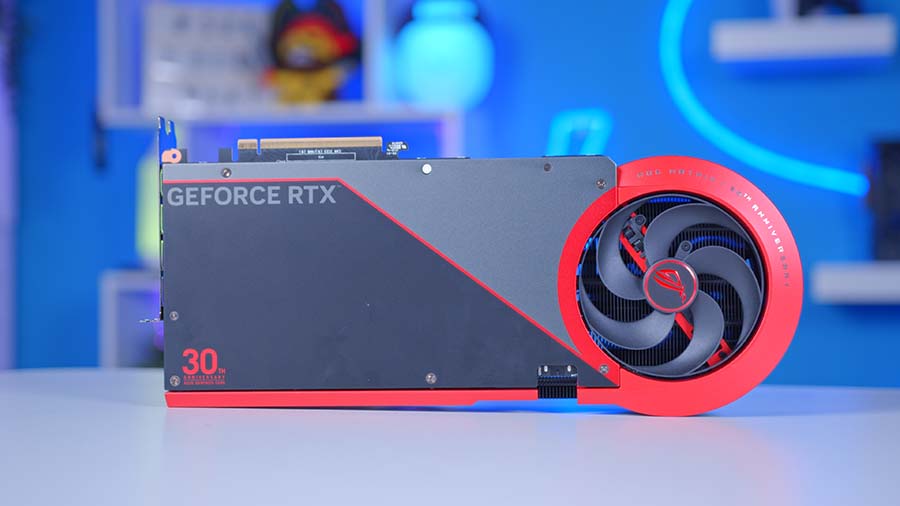
Perhaps the most impressive feat of the MATRIX RTX 5090 though, comes in the form of the dual power input design. This latest innovation from ASUS is directly responsible for enabling the otherworldly 800W power draw. When connected via both a 12V-2×6 cable and the high powered BTF High-Power adapter and compatible BTF motherboard, the potential performance output of the RTX 5090 not only increases but actually becomes accessible.
It doesn’t stop there either. In addition to the dual power-input, ASUS have implemented updates to GPU Tweak III. With this update the latest version of software now features Level sense technology, making use of the onboard PCB sensors to detect the angle at which the GPU sits and helping to avoid sagging issues. After running a quick calibration, should the GPU move pout of alignment, a pop-up notification in the app will appear detailing the issue.

Power detector + is another handy feature compatible with the MATRIX RTX 5090. Allowing for real-time monitoring of power draw across any of the 6 pins in the 12VHPWR Cable and notifying the end-suer of any anomalies.
Architecture
The RTX 5000-series utilises NVIDIA’s Blackwell architecture, which powers the pillar technologies that come with this card. Over the years, NVIDIA has continued to refine all of its major technologies, especially with the backing of AI. DLSS is one of these, with RTX 5000 bringing DLSS into its fourth iteration. DLSS 4.0 offers continued improvements to performance, alleviating overhead and offering better visual fidelity when enabled.
Additionally, Frame Generation now also supports Multi Frame Generation. Instead of generating one frame per every rasterised frame, Multi Frame Gen provides three, offering much smoother gameplay due to an exceptionally high framerate. For those looking for a more in-depth explanation of Multi Frame Generation and how it works, you can find out here.
Further to this, NVIDIA recently announced DLSS 4.5 at CES 2026, with a whole host of new features set to land in the coming months. Some of the standouts include the addition of both 5X and 6X Multi-Frame Generation, 6X frame generation now artificially generating five frames for every one rasterised frame. The 2nd generation of NVIDIAs Super Resolution is also set to start rolling out across more and more titles as we move further into the year, said to bring a significant improvement to perceived image and anti aliasing quality.
Performance
So, performance. For this test we put together a system featuring a Ryzen 9 9950X3D and 32GB DDR5 6000 MT/s RAM, and ran the tests once using a RTX 5090 Founders Edition and again using the MATRIX RTX 5090. No other hardware was changed and all tests were ran on the same driver and game version to keep the comparison as fair as possible. Now onto the results!
Marvel Rivals
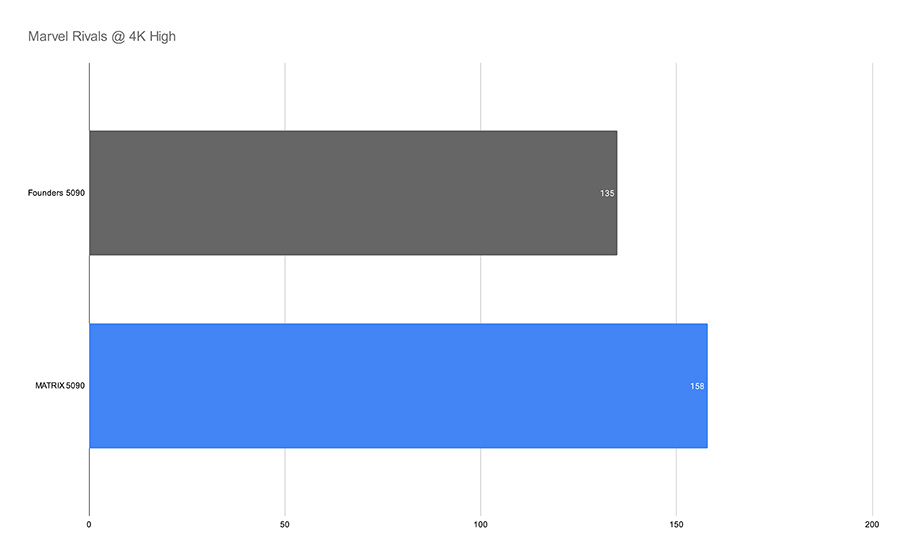
Straight out the gate, Marvel Rivals proved to be the perfect title for the MATRIX RTX 5090 to flex its muscles and pull in a whopping 158 FPS on average. Sitting on average between 20-25 FPS higher than than the Founders RTX 5080, the MATRIX seemingly benefits greatly from the additional bells and whistles. 4K proves to be no challenge for the MATRIX, with performance not only smooth but consistent too
Cyberpunk 2077
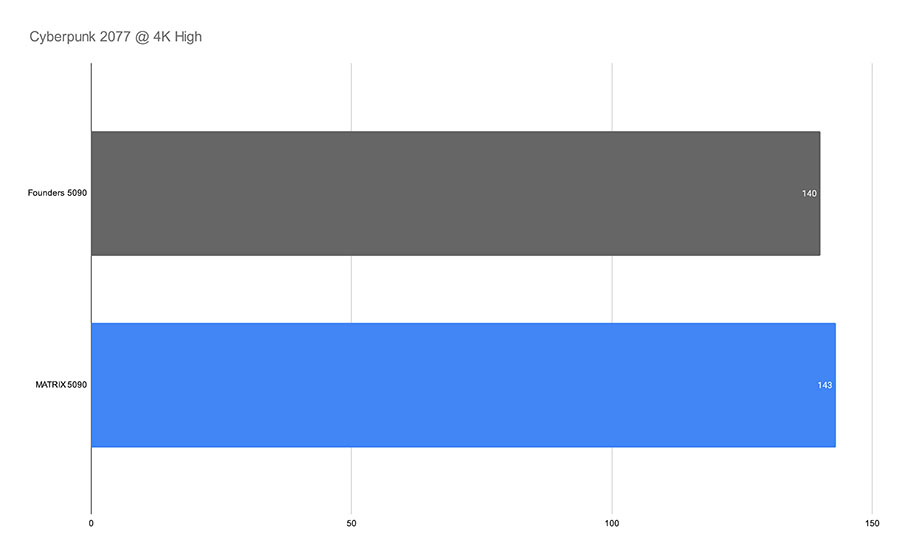
Cyberpunk 2077, an ever stay in our benchmark suite and for good reason, it’s a title capable of pushing GPUs to the absolute limit. The MATRIX 5090 however, not so much. The MATRIX card makes lightwork of Cyberpunk at 4K High settings, averaging a very healthy 143 FPS. Just the three frames total separate the MATRIX and Founders cards in this title however, but a win for the MATRIX is a win nonetheless, no matter how small.
F1 2025
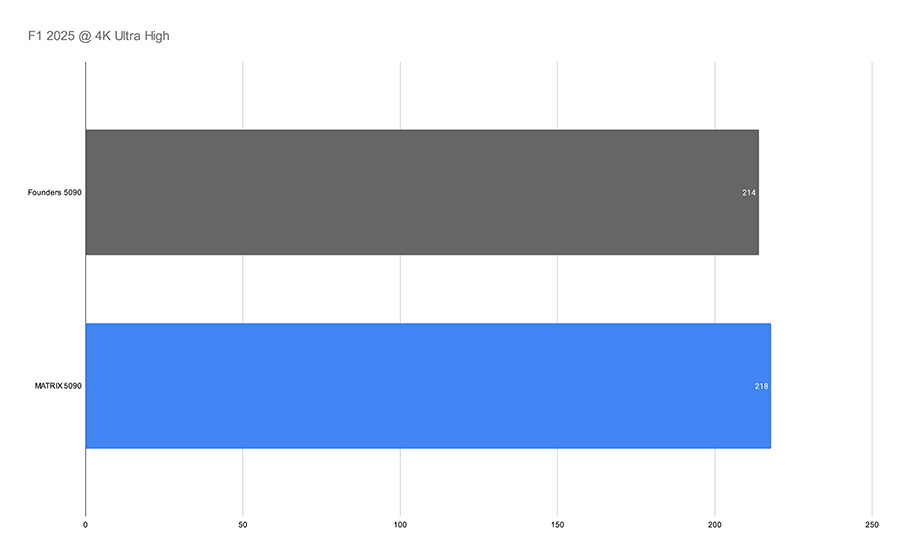
F1 2025, this time running at 4K Ultra High settings, is the final test for our comparison data and again, chalk up another win for the MATRIX 5090. Both cards pull in in excess of 215 FPS in what is frankly mind-boggling performance.